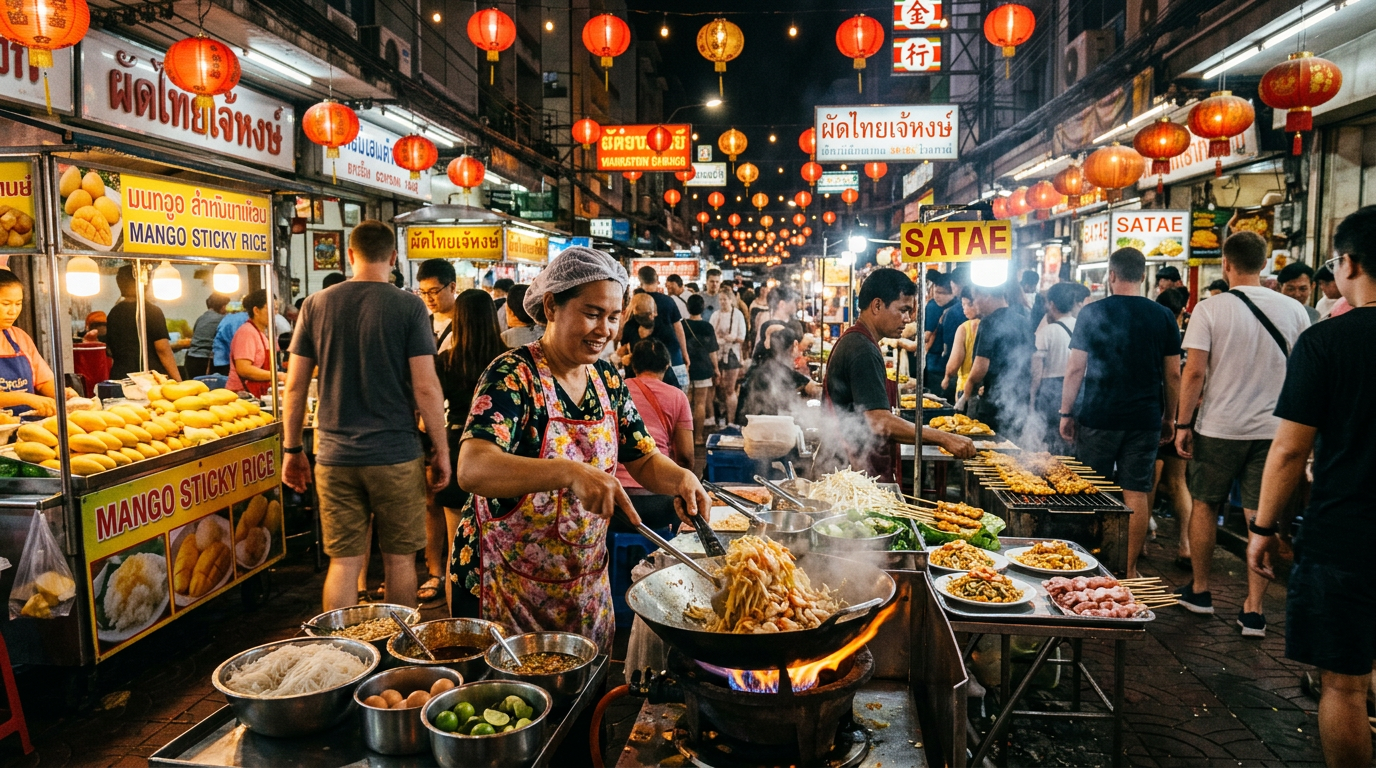
The street food stall is arguably the most democratic institution in world cuisine. There is no dress code, no reservation required, and no bill to cause anxiety. The transaction is direct: you indicate what you want, watch it prepared before you, pay a small amount, and receive something frequently more delicious than anything available in air-conditioned restaurants at ten times the price. Nowhere is this truth more vividly demonstrated than in Southeast Asia, where generations of cooking families have refined their single-dish specialities to a state of near-perfection that no restaurant kitchen, with its divided attentions, can match.
The great Southeast Asian port cities – Bangkok, Singapore, Penang, Hoi An, Ho Chi Minh City, and Yangon – each have distinctive street food identities shaped by their specific histories, trade routes, and immigrant communities. Understanding these differences requires time and repeated eating; a single market visit gives only a surface impression. But even that impression is generous with pleasure, and the serious eater who returns to the same city multiple times will find the rewards compounding with each visit.
Bangkok: The World's Street Food Capital
Bangkok's claim to the title of world street food capital is frequently made and rarely challenged. The Thai capital has an estimated 30,000 street food vendors operating at any given time, serving a population that eats outside the home more frequently than almost any other urban culture. The variety is genuinely overwhelming: pad thai (rice noodles stir-fried with egg, tamarind, and dried shrimp), khao man gai (poached chicken over rice cooked in chicken broth with an extraordinary dipping sauce), som tam (green papaya salad pounded in a mortar with chilli, fish sauce, lime, and dried shrimp), and the full spectrum of Thai regional curries, noodle soups, and grilled meats.
Yaowarat Road, Bangkok's Chinatown, is a particularly good destination for intensive street food exploration. The narrow alleyways contain vendors specialising in specific preparations – roast duck, dim sum, oyster omelettes, mango with sticky rice – operated by the same families for decades. The quality here is consistently excellent because competition is so intense and the customer base so knowledgeable that mediocrity is simply not viable. Eating in Yaowarat on a Friday evening, when crowds are thick and smoke from charcoal grills hangs in the humid air, is one of the most full-blooded urban dining experiences available anywhere in the world.
Singapore: The Hawker Centre System
Singapore's approach to street food reflects the city-state's broader character: it has taken a chaotic tradition and organised it into a model of efficiency without losing the essential quality that made it compelling. The hawker centre – a large covered food court with dozens of individually operated stalls, communal seating, and remarkable culinary diversity under one roof – is Singapore's most distinctive culinary institution. In 2020, Singapore's hawker culture was added to UNESCO's Intangible Cultural Heritage list – a recognition Singaporeans considered both justified and somewhat overdue.
Maxwell Food Centre, Tiong Bahru Market, Newton Food Centre – each hawker centre has its character and roster of must-visit stalls. Tian Tian Hainanese Chicken Rice at Maxwell is perhaps the most famous single dish at a Singapore hawker stall. Char kway teow – broad rice noodles stir-fried at intense heat with prawns, Chinese sausage, eggs, bean sprouts, and dark soy sauce – is one of those preparations that requires a specific wok, a specific heat intensity, and a precise sequence of additions that only sustained practice masters correctly. The best versions have a smoky, caramelised depth known as "wok hei" that is essentially impossible to replicate at home.
Vietnam: The Noodle Soup Philosophy
Vietnamese street food is dominated by the noodle soup in its many forms. Pho – the beef noodle soup of northern Vietnam, simmered for twelve or more hours with charred ginger and onion, star anise, cinnamon, and cloves – is now familiar to Western diners, but the difference between a bowl in Hanoi's Old Quarter and a bowl in London is difficult to overstate. The Hanoi version, served as the city's default morning meal, has a clarity and depth that illustrates the truth that great cooking is fundamentally about excellent raw materials and technique rather than complexity.
Bun bo Hue, the spicy beef noodle soup of the former imperial capital Hue, is pho's more assertive central Vietnamese cousin: darker, richer, perfumed with shrimp paste and lemongrass, served with thicker round noodles and sliced beef, pork knuckle, and occasionally congealed blood. Mi Quang, from coastal Da Nang, is a turmeric-coloured noodle dish with minimal broth but generous toppings of shrimp, pork, peanuts, and fresh herbs. Each soup encodes the specific geography and culinary preferences of its region as legibly as a dialect encodes a community's identity.
Penang: The Crossroads of Flavours
Penang's reputation as the street food capital of Malaysia is vigorously contested by Kuala Lumpur, but Penang's advocates argue convincingly that their city's Peranakan (Straits Chinese) culture – developed when Chinese immigrants intermarried with Malay communities centuries ago – gives its food a specificity that KL's more cosmopolitan offerings cannot match. Asam laksa – the sour, tamarind-based fish noodle soup that is Penang's most famous dish – has a flavour unlike anything else in Southeast Asia: aggressively sour, pungent with mackerel and shrimp paste, topped with cucumber, pineapple, and torch ginger flower in a combination that initially seems improbable but works with complete conviction.
The connection between great street food and port city history is nowhere more apparent than in Penang. The city's position on the Strait of Malacca brought waves of Chinese, Indian, Arab, and European traders whose culinary preferences fused with local Malay cooking to produce a hybrid cuisine of extraordinary range. Eating your way through Penang's hawker stalls is eating your way through five centuries of maritime trade and cultural exchange, each dish a sedimentary record of a specific meeting between peoples and cuisines.
Hoi An: Ancient Town, Vibrant Kitchen
The UNESCO World Heritage town of Hoi An in central Vietnam is small enough to walk across in twenty minutes yet packs a remarkable concentration of culinary history into its ancient streets. The town was an important trading port from the 15th to 19th centuries, and its cuisine reflects the Chinese, Japanese, French, and Indian influences that passed through its docks. Cao lau – thick noodles with slices of roasted pork, crispy rice crackers, fresh herbs, and a small amount of broth – is perhaps the most regionally specific dish in Vietnam: traditionally made only with noodles processed with water drawn from a specific well in the town, it serves as an edible monument to Hoi An's unique culinary identity.
White rose dumplings (banh bao banh vac), filled with minced shrimp and topped with fried shallots, are another Hoi An speciality with no real equivalent elsewhere. The dish is made by only a handful of families in the town, following recipes passed down over generations. Eating them at a table in the old town, watching the lantern-lit streets outside, is an experience that combines food pleasure with a palpable sense of historical continuity that is rarely available so directly in modern travel.
The lesson that Southeast Asia's street food cultures offer to any serious traveller is fundamentally about attention and slowness. The best street food is found not in the places with the largest crowds of tourists or the most Instagram-friendly presentation, but in the neighbourhood stalls that have been serving the same dish to the same community for decades. Finding these places requires time, curiosity, and a willingness to follow local guidance rather than guidebook recommendations. But the reward – a bowl of food that is simultaneously entirely simple and entirely irreplaceable – justifies the search completely.