The cruise ship of 2025 is not merely a larger and more luxurious version of its 1990s predecessor. It is a fundamentally different kind of vessel – a floating data centre, a connected IoT environment of extraordinary complexity, and a testbed for artificial intelligence applications that the hospitality industry has barely begun to explore. The transformation has been driven by passenger expectations shaped by smartphones and the seamless digital experiences of tech companies, by operational pressures that require ever-greater efficiency, and by environmental imperatives that demand intelligence about energy use at every level.
The guest-facing changes are the most visible. Carnival Corporation's Ocean Medallion – a small wearable device provided to passengers on Princess Cruises ships – epitomises the direction of travel. The medallion connects to 7,000 sensors distributed throughout the ship, enabling keyless cabin entry, automatic identification at food and beverage outlets, location-based services, and a personalisation layer that allows the ship's staff to greet passengers by name and anticipate their preferences before they have expressed them. It represents a fundamental rethinking of what the relationship between a ship and its passengers can look like.
The AI-Powered Guest Experience
Artificial intelligence is being deployed in cruise ships primarily in three domains: personalisation, operational optimisation, and safety. The personalisation applications are the most immediately apparent to passengers. Machine learning systems analyse booking data, onboard purchase history, activity participation, dining choices, and even the subtle behavioural signals captured by sensor networks to build increasingly accurate models of individual preferences. A passenger who books a Mediterranean cruise and shows consistent interest in cultural excursions, Italian food, and wine experiences should, ideally, receive targeted recommendations that reflect this profile throughout their voyage.
The challenge is implementing these capabilities in ways that feel helpful rather than intrusive. The most sophisticated deployments – Princess Cruises' JourneyView and MedallionClass systems, Royal Caribbean's OceanMedallion equivalent – have worked hard to make the personalisation feel organic rather than surveillance-like. The key design principle, according to developers working on these systems, is that passengers should feel that their ship is attentive to their preferences rather than tracking their movements. The distinction is subtle but genuinely important for passenger comfort.
Predictive Maintenance and Safety Systems
Below the passenger experience layer, AI is being deployed with considerable economic and safety significance in predictive maintenance systems. A modern cruise ship has tens of thousands of mechanical and electrical components, each with its own failure profile and maintenance schedule. Traditional maintenance approaches – based on time intervals and reactive repairs – are being replaced by condition-based systems that monitor the actual state of each component in real time and predict failures before they occur.
The financial implications are substantial. An unplanned engine failure at sea is not merely expensive in repair costs; it can require an emergency port diversion, missed port calls, passenger compensation, and potentially the repositioning of the entire vessel. The reputational cost of such events, in an era when passenger experiences are immediately shared on social media, adds further urgency to the case for predictive intelligence. Companies including ABB, Rolls-Royce Marine, and Wartsila are competing actively in this space, developing sensor-based monitoring systems that can analyse vibration patterns, temperature variations, oil chemistry changes, and dozens of other parameters to provide early warning of potential failures.
Smart Navigation and Fuel Optimisation
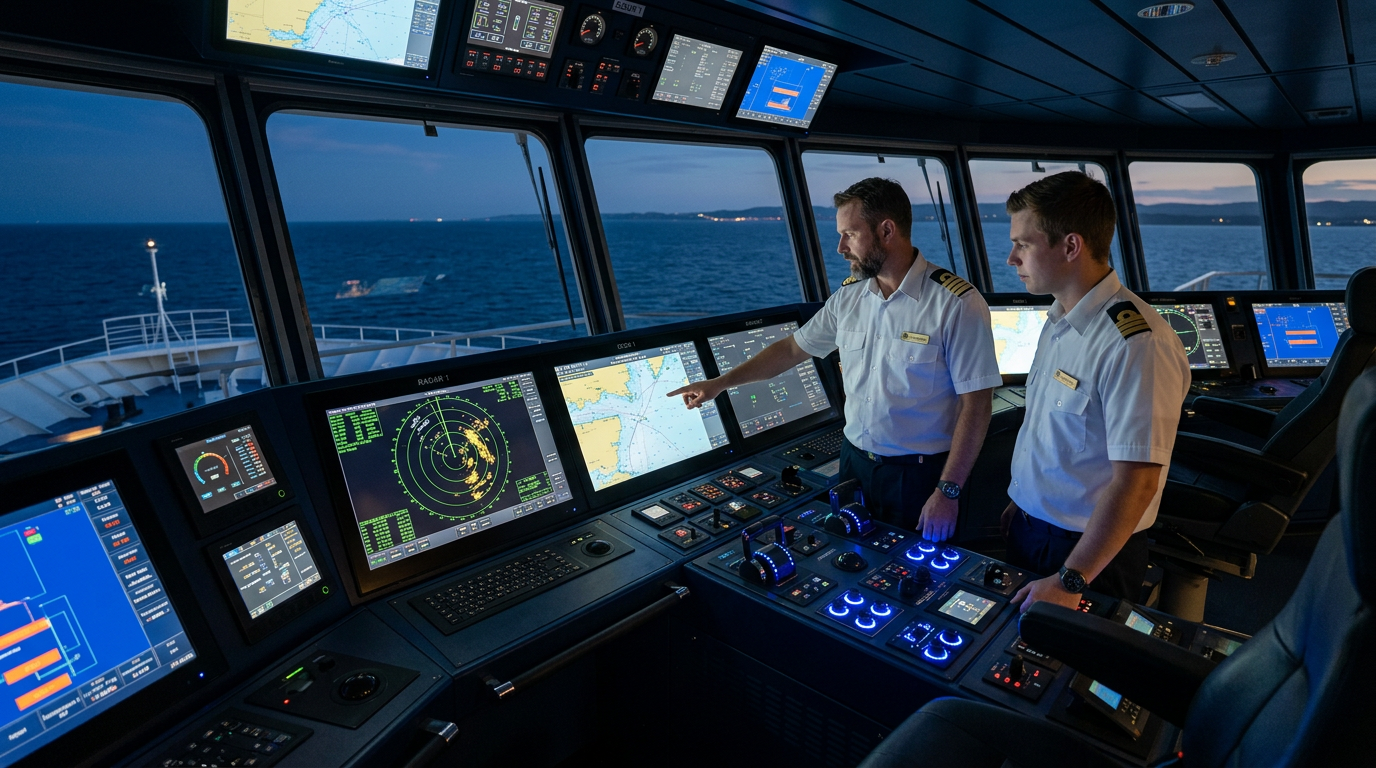
Navigation has been transformed by AI in ways that are largely invisible to passengers but have significant environmental and economic implications. Modern smart navigation systems integrate real-time weather data, oceanographic information, tidal models, and traffic separation schemes to calculate optimal routing that minimises fuel consumption while maintaining schedule compliance. The potential fuel savings from optimised routing are significant: even a 5% reduction in fuel consumption translates to millions of pounds in annual savings for a major cruise line, and a corresponding reduction in carbon dioxide and particulate emissions.
Speed optimisation is a related application: AI systems can calculate the precise speed profile for a voyage that minimises total fuel consumption, taking into account the quadratic relationship between speed and fuel use (doubling speed typically requires eight times the fuel), planned port arrivals, and current sea conditions. The result is a voyage that may include strategic slow-steaming sections punctuated by periods of higher speed, depending on the calculated optimal profile for the specific conditions encountered.
Internet Connectivity at Sea
The transformation of passenger internet connectivity at sea is perhaps the most practically impactful technology change in recent cruise industry history. Until relatively recently, satellite internet connections at sea were expensive, slow, and prone to interruption – a significant source of passenger dissatisfaction in an era of ubiquitous connectivity ashore. The deployment of low Earth orbit (LEO) satellite constellations – particularly SpaceX's Starlink and similar systems – has fundamentally altered this situation. LEO satellites, orbiting at 340–1,200 kilometres altitude rather than the 35,000 kilometres of traditional geostationary satellites, provide dramatically lower latency and, with sufficient satellite density, the bandwidth to support thousands of simultaneous users.
Several major cruise lines have already deployed Starlink and are reporting significant improvements in passenger satisfaction scores related to connectivity. The ability to work reliably from sea, to video call family members, and to stream entertainment content without buffering has removed one of the last remaining impediments to extended voyages for passengers with professional obligations.
Autonomous and Remote-Operated Vessels
The longer-term trajectory of smart ship technology points towards increasing autonomy. While full autonomous operation of passenger vessels remains years away – and raises regulatory, safety, and passenger-preference questions that require careful resolution – the technology development is progressing rapidly. Remote-operated vessels are already operating in certain commercial shipping contexts. The Yara Birkeland, a Norwegian electric container vessel, became one of the first commercially operating autonomous ships in 2022. The lessons learned from these early deployments are informing the development of autonomy-assistance systems on passenger vessels: not removing human officers from the bridge, but providing them with AI-driven decision support that reduces cognitive load and improves situational awareness.
The smart ship revolution is still in its early stages. The passenger-facing applications that feel advanced today – personalised service recommendations, keyless entry, AI concierge capabilities – will seem rudimentary within a decade. The operational and safety applications – predictive maintenance, autonomous navigation assistance, real-time emissions management – are developing at a pace that will require continuous adaptation from maritime professionals, regulators, and passengers alike. What is already clear is that the ships of the future will be as much software as steel, and that the intelligence embedded in them will be as decisive for their performance as the quality of their engineering.