There are seas and then there is the Mediterranean. For thousands of years, this inland body of water has served as the cradle of Western civilisation, the engine of trade empires, and the setting for countless epics, myths, and love stories. Sailing it today, one feels the weight of that history in every port, every ancient fortification, and every whitewashed village clinging to a sun-drenched cliff. The Mediterranean is not merely a travel destination – it is a living museum, a culinary laboratory, and an archive of the human story.
Choosing the right cruise route through these waters is both an art and a science. The Mediterranean spans 2.5 million square kilometres and touches 21 countries, so the options are genuinely staggering. Do you head east towards the ancient civilisations of Greece and Turkey? West towards the dramatic coastlines of Spain and Morocco? North to the theatrical harbour towns of the Italian and French Rivieras? Or do you craft a route that weaves through all of them, sampling the best of each? The answer, of course, depends on what you value most in travel.
The Eastern Mediterranean: Greece, Turkey, and the Islands
The eastern Mediterranean remains the most mythologically rich stretch of these waters, and for good reason. The Greek island chain alone comprises more than 200 inhabited islands, each with its own character, cuisine, and history. A route beginning in Athens and threading through the Cyclades – touching Mykonos, Paros, Naxos, Santorini, and Crete – offers an almost impossibly varied landscape: volcanic rock formations, Bronze Age ruins, Byzantine monasteries, and some of the most photographed sunsets on the planet.
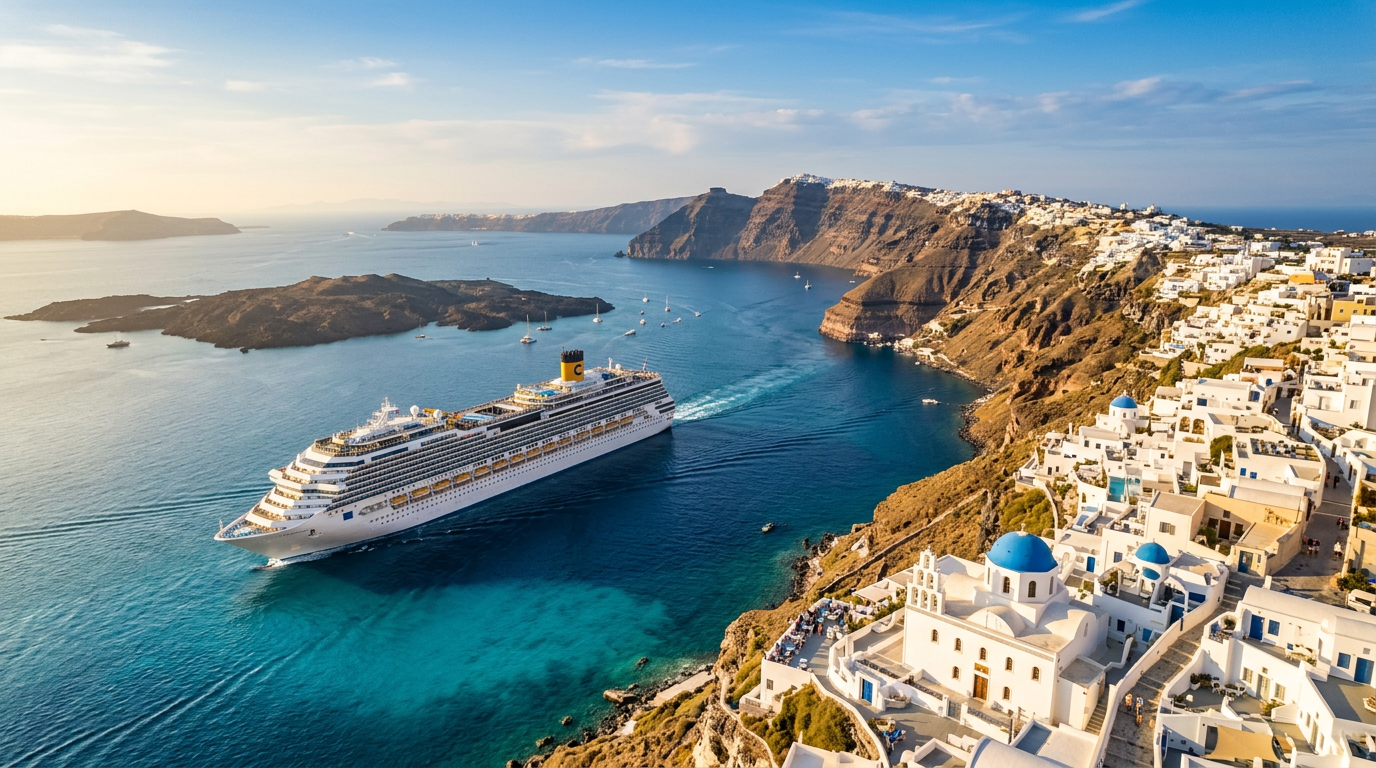
Santorini deserves special mention. The island's caldera, formed by one of the largest volcanic eruptions in recorded history around 1600 BCE, creates a setting so dramatic that photographs almost fail to capture it honestly. Arriving by ship into the caldera is a genuinely spine-tingling experience – the towering cliff walls, the tiny villages perched hundreds of metres above the water, the shimmering blue of the submerged crater. The island's wines, produced from ancient Assyrtiko grapes grown in volcanic ash, are among the most distinctive in the world and should not be missed.
Heading east from Greece into Turkish waters opens an entirely different chapter. The Turquoise Coast – so named for the colour of its waters – stretches from Bodrum to Antalya and encompasses some of the most spectacular sailing scenery in the world. Ancient Lycian ruins emerge from pine-covered hillsides. Secluded coves accessible only by boat invite spontaneous swimming stops. The coastal town of Kaş is a jewel of the Aegean; Ölüdeniz, with its famous Blue Lagoon, is one of the most photographed natural features in Turkey. A route incorporating the Dodecanese islands, particularly Rhodes and Kos, allows travellers to move seamlessly between Greek and Turkish culture in the space of a single morning.
The Western Mediterranean: Italy, France, and Spain
A cruise through the western Mediterranean offers an entirely different mood – one of glamour, art, and culinary indulgence. The Italian coastline alone could occupy an entire season of sailing. The Amalfi Coast, a UNESCO World Heritage Site, is arguably the most dramatic stretch of the Italian shoreline: cliffside villages in candy-bright colours, lemon groves cascading to the water's edge, roads cut impossibly into sheer rock faces. Positano, Ravello, and Praiano are all worthy of extended exploration. Capri, a short boat ride from the mainland, continues to embody a certain Italian ideal of beauty: grottos of unearthly turquoise light, villas with views that make the ordinary world seem grey by comparison.
Further north, the Italian Riviera and the French Côte d'Azur form a continuous ribbon of glamour along the Ligurian and Mediterranean coasts. Cinque Terre – five colourful villages connected by ancient footpaths along a rugged coastline – is one of the most distinctive sights in Italy, best appreciated from the water. Monaco, though tiny, offers a concentration of architectural extravagance and maritime history that rewards even a half-day visit. The old port at Villefranche-sur-Mer has been welcoming vessels since Roman times; the light there has attracted artists from Matisse to Picasso.
Spain's contribution to Mediterranean sailing is often underestimated. The Balearic Islands – Mallorca, Menorca, Ibiza, and Formentera – offer wildly different personalities compressed into a small geographical area. Mallorca's rugged Serra de Tramuntana mountains provide a dramatic backdrop to its northern coves; Menorca is the most architecturally preserved of the group, with Bronze Age megalithic sites and perfectly preserved Georgian-era British colonial buildings in Mahon harbour. Barcelona itself, with its extraordinary Modernist architecture, vibrant food markets, and sophisticated marina culture, makes one of the finest starting or finishing points for any western Mediterranean cruise.
The Adriatic: Croatia, Montenegro, and Albania
The Adriatic Sea, squeezed between Italy and the Balkans, has emerged over the past two decades as one of the most coveted cruising grounds in the entire Mediterranean. Croatia in particular has become a byword for spectacular coastal sailing. The Dalmatian Coast presents an almost bewildering succession of islands – over a thousand of them – sheltered bays, and fortified medieval towns. Dubrovnik, whose limestone walls have stood since the 7th century, remains the jewel of the coast; arriving by sea, with the full sweep of the fortifications and the terracotta rooftops catching the morning light, is a memory that endures long after the trip has ended.
Further up the Croatian coast, the islands of Hvar and Korčula offer their own rewards. Hvar is known for its lavender fields, Renaissance-era architecture, and some of the finest restaurants in the region. Korčula claims, almost certainly incorrectly but with considerable local pride, to be the birthplace of Marco Polo. Montenegro's Bay of Kotor, a drowned river canyon that resembles a fjord more than a Mediterranean bay, is one of the most astonishing natural harbours in Europe. The walled town of Kotor, with its Venetian palaces and Byzantine churches, rewards several hours of wandering. Boka Bay's mirror-flat waters, ringed by limestone mountains, create views of almost cinematic grandeur.
North Africa and the Western Islands
Few Mediterranean itineraries venture south of the European shoreline, which makes those that do all the more rewarding. Morocco's northern coast, the Canary Islands, and the island of Malta each offer perspectives on the Mediterranean that are entirely distinct from the more familiar European routes. Malta, in particular, is an island that rewards careful attention. Its capital, Valletta – the smallest capital city in the European Union – is a UNESCO World Heritage Site of extraordinary density: within a few square kilometres, Baroque palaces, 16th-century fortifications, and one of the world's finest natural harbours crowd together in a manner that makes exploration feel inexhaustible.
The Grand Harbour at Valletta, seen from the water at dawn as the golden limestone fortifications catch the first light, is one of the defining images of Mediterranean sailing. The island's own maritime history, including the Great Siege of 1565, is embedded in every stone. The Hypogeum of Ħal Saflieni, a Neolithic underground temple dating from 4000 BCE, is accessible to a limited number of visitors each day – worth booking months in advance. Sicily, visible on the horizon from Malta's northern coast, adds its own extraordinary layers: Greek temples at Agrigento, Baroque streets at Noto, and the brooding presence of Mount Etna, Europe's tallest active volcano.
Practical Considerations for Mediterranean Cruising
The best time to cruise the Mediterranean depends heavily on your priorities. High summer – July and August – brings maximum sunshine and warmth but also maximum crowds, particularly at the most popular ports. The shoulder seasons of May, June, September, and October offer a more balanced experience: warm enough for swimming, busy enough for vibrant ports, but without the queues and inflated prices of the peak weeks. Spring in particular brings wildflowers across the hillsides of Greece and Croatia, a spectacle that rewards early risers who venture inland from their ships.
When choosing a route, consider the ratio of sea days to port days that suits your travel style. Some cruisers prefer to spend long hours at anchor exploring each port in depth; others prefer the contemplative rhythm of open-water sailing with briefer, more curated port visits. The size of your vessel matters enormously here. Larger ships provide more amenities but are excluded from many of the smaller, more beautiful harbours. A yacht or small expedition vessel can access coves and anchorages that are simply inaccessible to a conventional cruise ship, offering a profoundly different kind of Mediterranean experience.
Whichever route you choose, the Mediterranean will reward your attention with a generosity that is difficult to overstate. The light here – that legendary Mediterranean light that has driven painters mad for centuries – does something extraordinary to everything it touches: the sea, the stone, the faces of people at table in the early evening. It is a quality that photographs hint at but cannot reproduce. For that, there is only one solution: you have to go yourself.