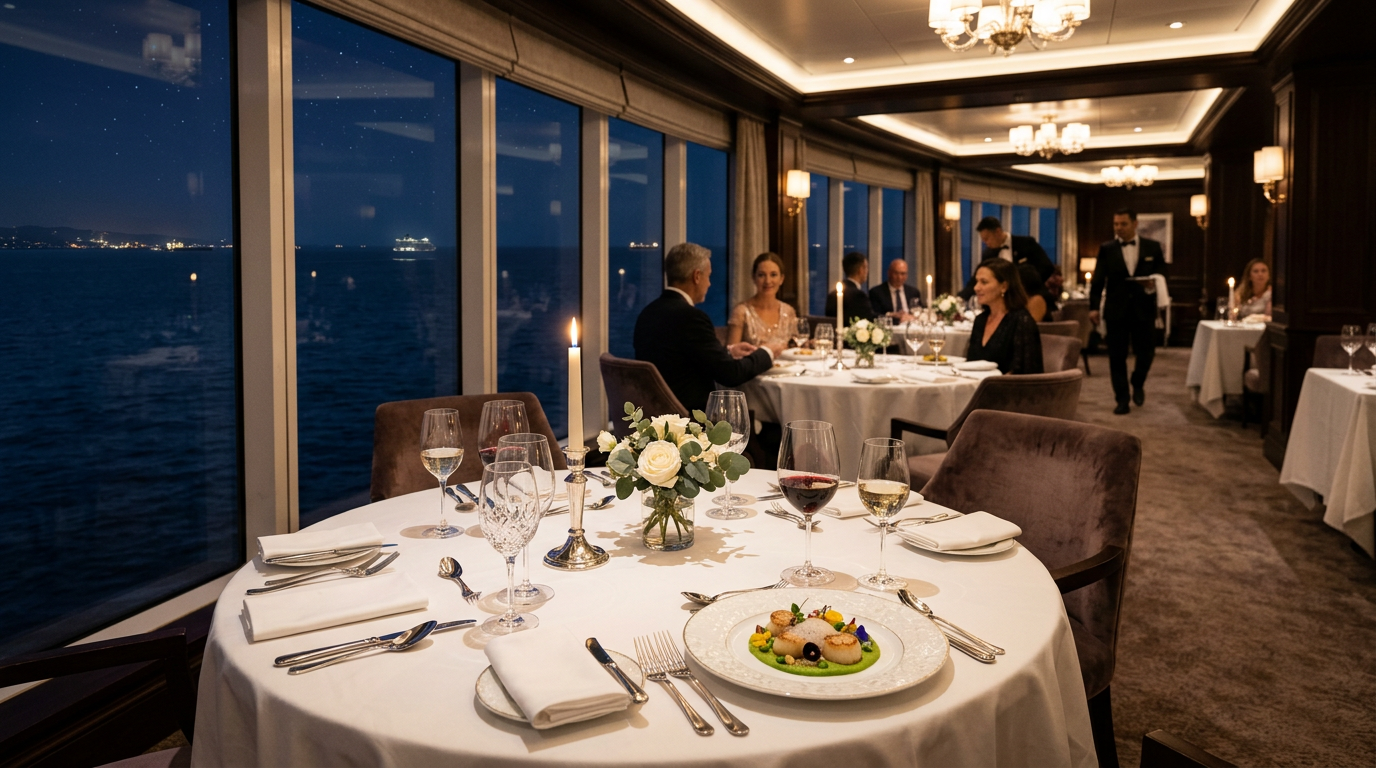
The transformation of dining at sea over the past fifteen years represents one of the most significant shifts in the cruise industry's history. Where once a ship's restaurant was measured primarily by the generosity of its portion sizes and the reliability of its pasta bar, today the conversation is entirely different: guest chefs with Michelin stars, farm-to-table sourcing programmes, dedicated sommelier teams, and tasting menus that take four hours and fifteen courses to deliver. Cruise ship dining has become, for serious food lovers, a genuine reason to book.
The shift began with a recognition that passengers – particularly those choosing premium and luxury lines – were becoming far more sophisticated in their culinary expectations. A generation of travellers who had experienced the restaurant revolutions in London, New York, Tokyo, and Copenhagen was no longer willing to tolerate institutional catering at sea, regardless of how spectacular the view from the dining room window might be. The cruise lines that responded most intelligently to this shift – particularly those at the luxury end of the market – have been rewarded with passionate and loyal followings.
The Celebrity Chef Revolution
The involvement of celebrity chefs in cruise ship dining began as a marketing strategy and evolved into something more genuinely substantial. The best collaborations go far beyond name endorsement: they involve real creative input, staff training, dedicated procurement relationships, and regular quality control visits by the chef or their team. The result, on the best ships, is food that genuinely reflects the chef's philosophy and creativity rather than merely bearing their name above the door.
Nobu Matsuhisa's involvement with Crystal Cruises brought his celebrated Japanese-Peruvian fusion to the high seas in a form that matched what guests could expect in his shore-based restaurants. Thomas Keller's partnership with Seabourn resulted in what many consider the finest food available on any cruise ship – his French Laundry-influenced approach to classical American cuisine, translated with remarkable fidelity to a seagoing context. The key to these successful collaborations is the willingness of the chef to adapt their vision intelligently to the constraints of a ship's kitchen: the challenge of provisioning in remote ports, the importance of stability in rough weather, and the need to serve several hundred covers each evening.
Sourcing and Sustainability
The question of where a ship's food comes from has become as important to discerning passengers as it has to diners at progressive shore-based restaurants. The best cruise lines have developed sophisticated provisioning networks that prioritise local sourcing at each port of call, supplemented by carefully selected producers for staple items maintained in the ship's cold storage. A Mediterranean cruise might take on Sicilian capers, Greek feta, Provençal olive oil, and Spanish jamón ibérico at successive ports, each item purchased at its source and incorporated into menus that reflect the culinary geography of the sailing route.
Seafood sourcing is a particular focus for environmentally conscious lines. The Marine Stewardship Council's certification has become a baseline expectation for premium cruise lines, with some going considerably further. Viking Ocean Cruises sources a substantial proportion of its seafood from Norwegian and Icelandic suppliers who can demonstrate full traceability, while several luxury lines have eliminated the serving of endangered species entirely. The Monterey Bay Aquarium's Seafood Watch programme has been adopted as a procurement framework by a number of forward-thinking cruise operators.
Wine and the Sommelier Programme
A ship at sea cannot simply send out for another case of Burgundy when supplies run short, which means wine procurement for a major cruise vessel is an exercise in extraordinary logistical and financial planning. The finest cruise wine programmes are curated by Master Sommeliers or equivalently credentialled professionals who work months in advance of each voyage to select bottles appropriate to the sailing route, the menu, and the likely preferences of the booked passenger demographic. Seabourn's wine list, for instance, has won multiple awards from wine industry publications and typically carries several hundred labels, including vertical collections of great Bordeaux and Burgundy estates that would make any serious collector envious.
Tasting events at sea have become a significant amenity on premium and luxury lines. A typical programme might include a structured introduction to the wines of a region to be visited, a guided vertical tasting of a single estate's releases across multiple vintages, or a masterclass on food and wine pairing conducted by the ship's Head Sommelier. These events not only educate and entertain passengers but create a sense of engaged community around the table that enhances the overall dining experience.
The Best Cruise Dining Experiences by Category
Luxury ocean dining: Seabourn and Silversea consistently lead the field in terms of overall dining quality, combining excellent raw materials with genuinely accomplished kitchen technique. The Restaurant on Seabourn ships, with its open seating policy and seasonally changing menu, represents a standard that shore-based restaurants of comparable ambition would be proud to maintain. Silversea's La Dame, the fleet's signature French restaurant, offers a tasting menu experience – with optional wine pairings selected by the restaurant's dedicated sommelier – that would receive serious consideration in any Michelin Guide.
River cruise dining: Viking River Cruises has elevated the standard for river cruise dining significantly, with regionally inspired menus that change as the ship moves through different culinary territories. A Rhine cruise dinner might feature Alsatian tarte flambée followed by Bavarian schnitzel; the following evening, sailing into Switzerland, the menu reflects a different culinary tradition entirely. This genuine engagement with the food culture of each region is one of the most pleasurable aspects of the river cruise experience.
The Art of the Multi-Course Tasting Menu at Sea
The tasting menu – typically eight to fifteen courses, each a small-portion composition designed to showcase a specific ingredient or technique – has become the signature format of the most ambitious cruise ship restaurants. At its best, a shipboard tasting menu can match or exceed the quality of comparable experiences ashore, particularly when the kitchen has the advantage of ultra-fresh local produce sourced that morning in port. The additional element of dining as the sun sets over the open ocean, or as the ship navigates a narrow fjord at dusk, adds a sensory dimension that no landlocked restaurant can replicate.
The logistics of executing a multi-course tasting menu for multiple simultaneous diners at sea are genuinely impressive. Temperature control in a moving kitchen requires additional stabilisation equipment; storage of delicate ingredients requires precise environmental management; the training of a kitchen brigade that can maintain consistent standards voyage after voyage, often with significant crew rotation, is a management achievement that deserves recognition. The passengers who benefit from this sustained effort are, increasingly, people who care deeply about food and who approach a good meal at sea with the same attentiveness they would bring to a special occasion ashore.
The future of cruise ship dining is likely to see further integration of technology – precision cooking equipment, AI-assisted menu planning for dietary requirements, temperature-controlled ingredient delivery drones in certain ports – alongside a continued emphasis on human craftsmanship and the irreplaceable quality of food prepared by skilled hands. Whatever form it takes, the trajectory is clear: dining at sea has become one of the most compelling arguments for choosing a cruise over any other form of travel.