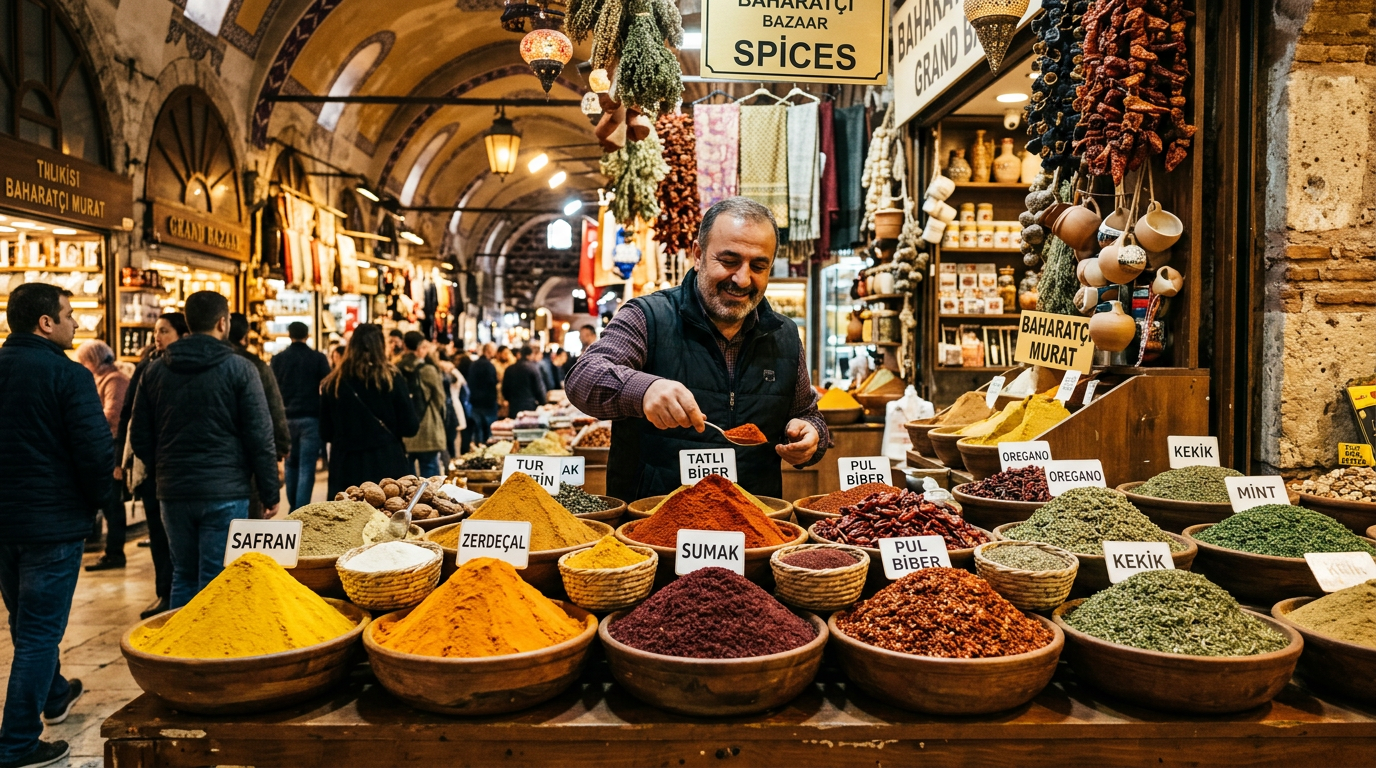
The history of global trade is, in a very real sense, the history of spice. For thousands of years, the most coveted and financially significant commodities in the world were dried seeds, bark, roots, and fruits that transformed food from mere sustenance into pleasure. The merchants who controlled these routes – Venetian, Portuguese, Dutch, Arab, and Indian – amassed fortunes that shaped the political map of the modern world. And the port cities that stood at the nexus of these routes accumulated not merely wealth but something more durable: a culinary complexity that still distinguishes them from inland cities today.
Istanbul, sitting at the junction of Europe and Asia where the Bosphorus connects the Black Sea to the Mediterranean, has been a spice trading centre for more than two thousand years. The Egyptian Spice Bazaar (Misir Carsisi), built in 1664 and still operational today, is the oldest covered market in the city and offers a sensory experience of considerable intensity: mountains of saffron, pyramids of sumac and za'atar, jars of rose petals and dried hibiscus, bags of wild thyme collected from the hills of Anatolia. Walking its length is an education in the flavour geography of an entire region.
Istanbul: Where Continents Meet on a Plate
Turkish cuisine is among the most underestimated in the world. The Ottoman culinary tradition – still alive in Istanbul's finest restaurants and home kitchens – represents one of the most sophisticated and historically layered food cultures in existence. The Ottoman palace kitchens at Topkapi employed hundreds of cooks organised into specialist divisions: bread bakers, halvah makers, yoghurt specialists, meat roasters, and preserving experts. The recipes developed in those kitchens over five centuries formed the basis of a culinary tradition spanning from the Balkans to the Middle East.
Key Istanbul flavours include the sweet-sour complexity of pomegranate molasses, the earthy depth of dried red pepper paste, the floral warmth of rose water used in both savoury and sweet contexts, and the fundamental richness of long-cooked lamb with dried fruits and nuts. Meze culture – the sharing of many small dishes – allows maximum exploration of the cuisine's range within a single meal. The meyhane restaurants of Beyoglu serve meze with ice-cold raki in a ritual essentially unchanged for over a century.
Mumbai: The Spice Capital of India
Mumbai is India's most culinarily diverse city. Its history as a colonial trading port – first Portuguese, then British – and its development as India's commercial capital have made it a convergence point for culinary traditions from across the subcontinent and beyond. A single afternoon of eating in Mumbai can encompass the vindaloo tradition of Goan Portuguese-Indian fusion, the sophisticated Parsi cuisine of Zoroastrian immigrants, the street food of Maharashtra's communities, and the extraordinary Mughlai cooking of the city's Muslim merchants.
Parsi cuisine – one of India's most extraordinary culinary traditions – deserves special attention. Dhansak, the elaborate lentil and lamb stew with Parsi spice blends served with caramelised rice on Sundays, is a dish of remarkable complexity. Patra ni macchi, a pomfret fillet marinated in green coconut chutney and steamed in banana leaves, demonstrates extraordinary delicacy. These are cuisines shaped by a 1,200-year migration history, maintained with fierce pride across dozens of generations.
Zanzibar: The Spice Island
Zanzibar's claim to the title of Spice Island is more than marketing rhetoric. The island was the world's principal supplier of cloves for much of the 19th century and remains a significant producer of vanilla, black pepper, cinnamon, nutmeg, and turmeric. A spice farm tour on Zanzibar constitutes an impromptu lecture in culinary and economic history: the extraordinary variety of plants, and the stories of how each arrived via the Indian Ocean trading network, compress centuries of global exchange into a single morning.
Zanzibari cuisine is the product of spice abundance combined with Arab, Indian, Swahili, and Portuguese influences. The night market at Forodhani Gardens in Stone Town is one of the finest street food experiences in East Africa: grilled octopus marinated in coconut and chilli, Zanzibar pizzas (fried dough stuffed with eggs and vegetables), spiced sugarcane juice, and urojo (a tamarind-based soup with bhajia, potatoes, and mango) are all prepared fresh in a carnival of smoke, colour, and fragrance.
Lisbon: The Atlantic Spice Gateway
Lisbon occupies a unique position in the history of the spice trade as the city that, more than any other, made that trade global. When Vasco da Gama returned to Lisbon in 1499 having found a sea route to India around Africa's Cape of Good Hope, he transformed the economics of spice distribution in a single voyage. For the next century, Lisbon was the spice capital of Europe: the city through which pepper, cinnamon, cloves, and nutmeg from Asia flowed into European markets, making Portugal briefly the wealthiest nation in the world.
That history is legible in Lisbon's food today, though perhaps subtly for the casual visitor. The combination of cinnamon with savoury dishes – in caldo verde (the kale soup), in carne de porco à alentejana (pork with clams), and in numerous pastry preparations – reflects centuries of easy access to a spice that was prohibitively expensive for most of Europe. The extraordinary pastéis de nata (custard tarts with cinnamon), created by monks at the Jerónimos Monastery in Belém and still made there today, are perhaps the most emotionally charged bite of food available in Portugal: five hundred years of history compressed into a warm, flaky, barely sweet pastry shell.
Goa: Where Portuguese and Indian Spices Fused
The Portuguese colonial possession of Goa, on India's southwestern coast, was held for over 450 years and created a culinary tradition unique in the subcontinent: one where European vinegar-based preservation techniques met Indian spice complexity to produce preparations that are neither properly Indian nor properly Portuguese but entirely their own thing. Vindaloo – now a byword in British Indian restaurants for maximum heat – was originally a Goan preparation of pork marinated in wine vinegar (the word derives from vinho d'alhos, Portuguese for wine with garlic) with local spices including the extraordinarily hot Kashmiri chilli introduced to India by the Portuguese.
The xacuti curry, with its complex spice blend including white poppy seeds, grated coconut, star anise, and dried Kashmiri chillies, has no parallel in the rest of Indian cuisine and speaks to a fusion of technical influence and ingredient innovation that occurred over centuries of cultural exchange in this specific port city. Eating vindaloo or xacuti in Goa, made from locally raised pork, fresh-ground spices, and wine vinegar, is eating a dish that could only have come from a place where these two great culinary traditions met and chose to remain.
The living legacy of the spice trade cities is expressed in kitchens, not museums. Every time a cook in Istanbul adds sumac to a salad, or a home baker in Lisbon dusts cinnamon over a custard tart, or a Zanzibar grandmother grinds fresh cloves into a marinade, they are participating in a tradition of flavour exchange that has been operating continuously for centuries. For the travelling food lover, these cities offer something unavailable in any cookbook: the taste of history, still warm from the stove.