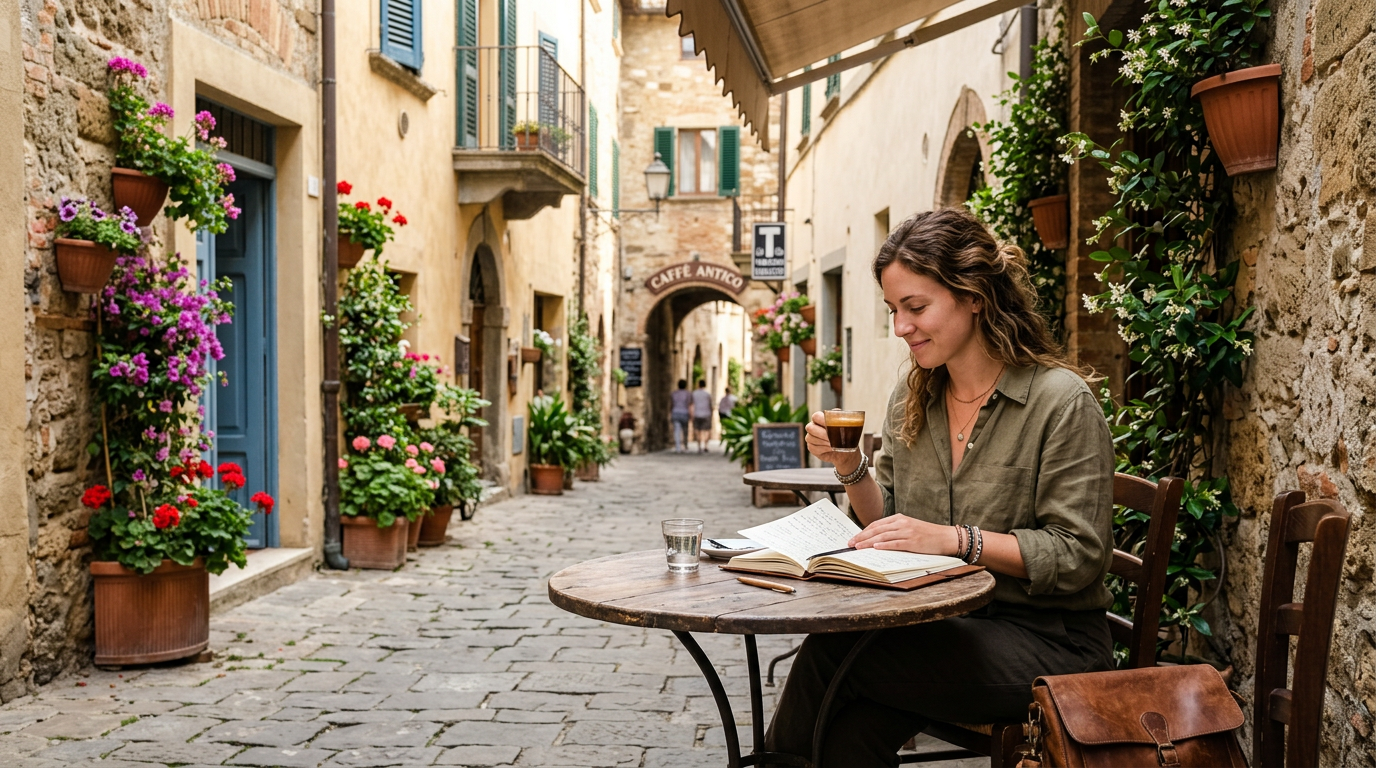
The concept of slow travel has emerged over the past two decades as a considered response to the dominant pattern of modern tourism: brief trips packed with as many destinations and experiences as possible, optimised for Instagram-worthy moments rather than genuine engagement, and measured in landmarks visited rather than connections made. Slow travel advocates a fundamentally different relationship with the experience of being somewhere: staying long enough to develop a sense of local rhythm, returning to the same café until the owner remembers your order, learning a few words of the local language, and allowing the unexpected to occur without anxiety.
The term draws loosely on the broader Slow movement that emerged from Carlo Petrini's Slow Food initiative in Italy in the late 1980s: a philosophy of deliberate pace, quality over quantity, and attention to the intrinsic value of experience over the efficient accumulation of outcomes. Applied to travel, the slow principle suggests that a single month in one city will yield a richer experience than a month moving through ten cities – that depth of engagement is more valuable than breadth of destination.
What Slow Travel Actually Means in Practice
Slow travel is less a prescriptive itinerary style than a set of values and preferences that express themselves differently for different travellers. For some, it means renting an apartment rather than staying in hotels, cooking some meals rather than eating out for every one, visiting local markets and ordinary neighbourhood streets rather than only tourist sites. For others, it means choosing to travel by train, ferry, or even bicycle rather than flying whenever distance permits, treating the journey itself as part of the experience rather than a necessary inconvenience to be minimised.
The common thread is intentionality: a decision to be genuinely present in a place rather than efficiently processing it. A slow traveller in Lisbon might spend three days exploring a single neighbourhood – its morning cafés, its afternoon shadows, its evening restaurants – and return from the trip with a specific understanding of one city in one season that no amount of hurried touring could provide. The souvenirs of slow travel are not physical objects but specific memories: a particular conversation, an unexpected friendship, a moment of unexpected beauty on a street corner that no guidebook had recommended.
The Environmental and Economic Case
Beyond its personal benefits, slow travel has a compelling environmental dimension. Aviation is responsible for approximately 2.5% of global CO2 emissions, but its total climate impact – including contrail formation and other high-altitude effects – may be considerably larger. A travel style that minimises flying in favour of overland and sea travel, and that concentrates visits in fewer destinations for longer periods rather than making frequent short trips, produces a significantly smaller carbon footprint than conventional tourism patterns.
The economic case is also often surprising: slow travel, despite its assumption of extended trips, frequently costs less per day than rapid multi-destination travel. Accommodation rates are typically lower for stays of a week or more than for single nights. Cooking occasionally rather than eating out for every meal reduces food costs substantially. Local transport used daily becomes familiar and economical rather than stressfully novel. And the absence of constant transit costs – airport transfers, inter-city trains, luggage fees – contributes significantly to a lower overall daily expenditure.
Choosing Destinations for Depth
Not all destinations are equally well-suited to slow travel. Places with a strong local culture, a varied landscape, a distinctive food scene, and neighbourhoods that reward exploration on foot tend to offer far more for extended stays than places whose principal assets are concentrated in a few flagship attractions. Small cities and large towns often work better than the world's mega-cities for slow travel: they are comprehensible enough to develop genuine familiarity within a few weeks, but complex enough to keep revealing new dimensions throughout an extended stay.
Islands occupy a special place in the slow travel imagination, and for good reason. The natural boundaries of island geography create a sense of completeness and containability that is difficult to achieve on a mainland. An island can be known – not completely, but genuinely – in a way that a continental region rarely can. The best slow travel islands offer a combination of natural landscape, cultural depth, good food, and sufficient infrastructure to make extended stays comfortable: examples include Sardinia, Madeira, the Greek islands beyond the most-visited, the Azores, and the Canary Islands' lesser-known members.
Sea Voyages and the Ultimate Slow Travel Experience
Few forms of travel embody slow principles more completely than extended sea voyages. The ocean crossing, whether by ocean liner, sailing yacht, or cruise ship, removes the traveller entirely from the pattern of rapid ground-covering that characterises most contemporary travel. At sea, the destination is reached when it is reached; the day's activities are shaped by weather, light, and the rhythm of the vessel rather than by itinerary; and the sea itself becomes the landscape, as endlessly varied in its moods and colours as any mountain range or coastline.
Extended cruise itineraries – particularly repositioning voyages and world cruises – have long attracted travellers who understand that the voyage itself is the experience. A three-week transatlantic crossing is not a means of getting from Southampton to New York; it is an experience complete in itself, with its own society, its own daily rhythms, and its own particular kind of beauty that cannot be found anywhere on land. The travellers who find these voyages most rewarding are typically those who have already internalised the slow travel philosophy: people who are comfortable with their own company, genuinely curious about the world, and able to find interest in the ordinary as well as the exceptional.
The practical barriers to slow travel – primarily the constraint of limited holiday allowances in conventional employment – are real but not always insurmountable. Remote working arrangements, sabbaticals, and career breaks have made extended travel possible for a wider range of people than at any previous time. And even within conventional holiday constraints, the slow travel principle can be applied at smaller scales: choosing one good destination and staying for two weeks rather than visiting four destinations in a fortnight, spending more evenings in residential neighbourhoods and fewer at tourist-oriented restaurants, and allowing at least one day of each trip to have no fixed itinerary whatsoever.