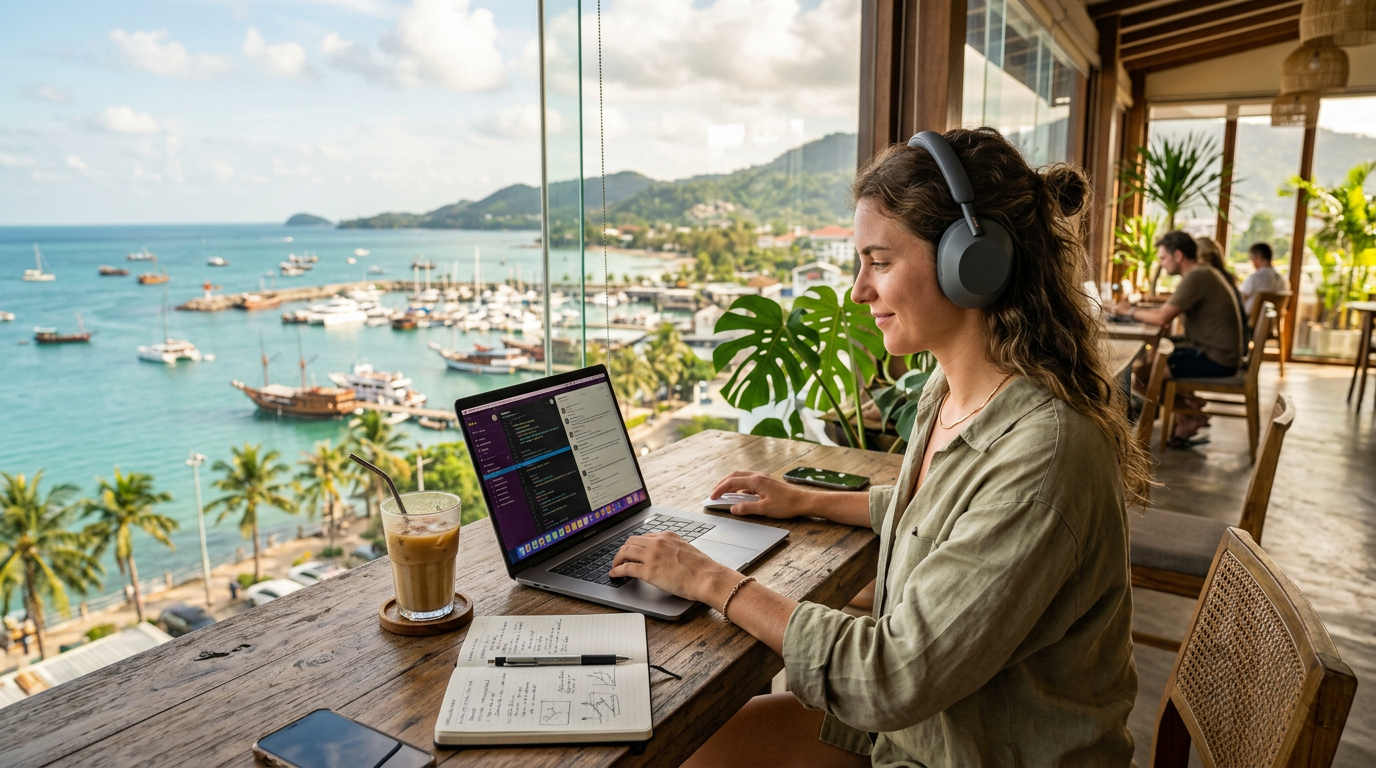
The number of people working remotely while travelling has grown dramatically since the global expansion of remote work arrangements. What was once the lifestyle of a relatively small community of freelancers, developers, and writers has become accessible to a much broader range of professionals, including employees of large organisations who have negotiated long-term remote arrangements. The infrastructure supporting this lifestyle – co-working spaces, digital nomad visas, coliving developments, and the dramatic improvement of mobile internet coverage – has evolved rapidly to meet the demand.
The appeal is obvious: the ability to experience different cultures, climates, and environments while maintaining a productive professional life. The reality, for those who approach it thoughtfully, can genuinely deliver on this promise. But digital nomadism done poorly – constant movement, poor workspace choices, inconsistent connectivity, and an inability to establish productive routines in unfamiliar environments – produces burnout, compromised work quality, and a superficial experience of places that allows neither the depth of genuine travel nor the focus of genuine work.
Choosing Destinations for Remote Work
The criteria for choosing destinations as a digital nomad differ significantly from those that apply to conventional holiday travel. Time zone compatibility with colleagues and clients is often the most important single factor: working from South-East Asia while maintaining synchronous communication with a UK-based team requires either unusually flexible hours or a particular type of role that is largely asynchronous. Time zones within four to five hours of home base typically allow functional overlap for meetings while still offering the sense of genuine displacement that makes remote working while travelling worthwhile.
Internet reliability is the non-negotiable practical requirement. The speed and reliability of internet access varies dramatically even within individual countries, between urban and rural areas, and between different accommodation types. Checking current nomad community resources – platforms such as Nomad List and community forums for specific destinations – provides real-world data on connectivity that tourist guides and booking platforms do not. A destination rated highly for internet reliability by the community will almost certainly deliver adequate connectivity; a destination with poor ratings should prompt either careful investigation or reconsidering the choice.
Co-working Spaces and Productive Environments
The co-working space has become one of the defining institutions of the digital nomad lifestyle. Good co-working spaces provide not only reliable internet and a quiet, ergonomically reasonable working environment but also the professional social context that is otherwise difficult to maintain while travelling. The serendipitous conversations in a co-working café – with other nomads, local entrepreneurs, and long-term residents – often provide both professional connections and local insights that would take weeks to accumulate through other means.
The economics of co-working spaces vary considerably. In South-East Asian destinations including Bali, Chiang Mai, and Ho Chi Minh City, a full month's membership at a well-equipped space may cost less than a week's hot-desking in London or Amsterdam. In European destinations, prices are generally comparable to or slightly below major city office rents. The value equation is favourable in most cases: the combination of reliable internet, professional environment, community access, and separation of work from accommodation is worth considerably more than the cost in almost any reasonable comparison.
Managing Time Zones and Communication
Time zone management is a practical skill that takes most people several experiences to fully develop. The first mistake is underestimating the cumulative effect of significant time differences on sleep quality and cognitive performance: working evenings to maintain European hours while based in Asia is manageable for short periods but creates sustained fatigue over weeks or months. The sustainable approach is either choosing destinations with comfortable time zone overlap or, where this is not possible, being explicit with employers and clients about working hours and designing communication patterns that minimise real-time synchronisation requirements.
Asynchronous communication tools – well-structured email, project management platforms, shared documents, and recorded video updates – are the foundation of sustainable remote work across significant time differences. Managers and colleagues who are comfortable with asynchronous workflows create the conditions under which genuinely location-independent work becomes possible. Organisations where every question requires a real-time answer and every decision is made in a synchronous meeting are, in practice, very difficult to work for from a remote location in a different time zone.