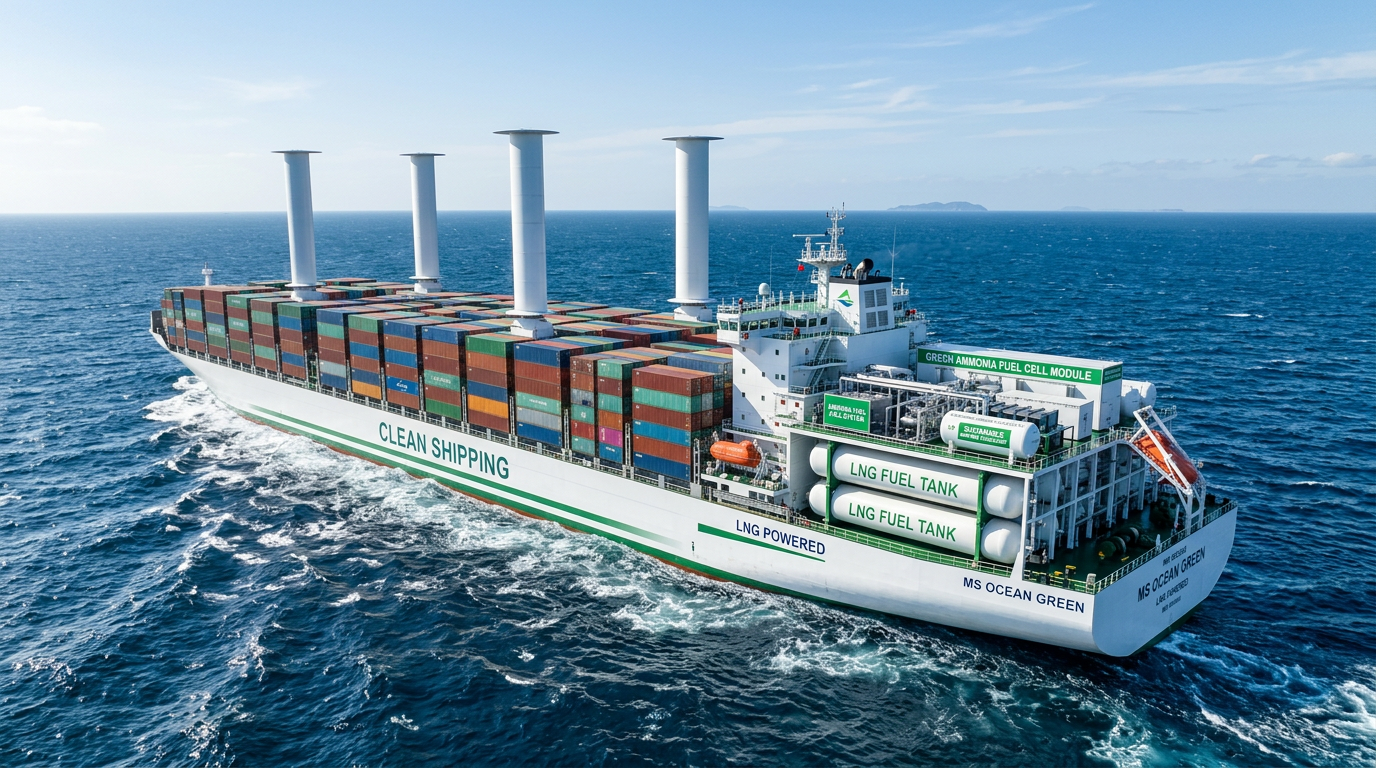
The shipping industry is responsible for approximately 2.5% of global greenhouse gas emissions – a figure that, while smaller than aviation or road transport on a per-kilometre basis, represents a significant absolute contribution to climate change given the sheer volume of goods moved by sea each year. More than 90% of the world's traded goods travel by ship at some point in their journey from producer to consumer, making maritime transport one of the most fundamental systems in the global economy and one whose decarbonisation carries correspondingly large stakes.
The International Maritime Organization (IMO) has set a target of reducing total greenhouse gas emissions from international shipping by at least 50% compared to 2008 levels by 2050, with an ambition for full decarbonisation as soon as possible within this century. Achieving this target requires nothing less than the complete transformation of how ships are powered – a challenge on a scale comparable to the transition from sail to steam in the 19th century, but compressed into a fraction of the time.
LNG: The Transitional Fuel
Liquefied natural gas (LNG) has emerged as the primary transitional fuel for the maritime industry – a bridge technology that offers significant environmental improvements over conventional heavy fuel oil while the infrastructure for zero-emission alternatives is developed. LNG-powered ships emit approximately 20-25% less carbon dioxide than equivalent heavy fuel oil vessels, and virtually eliminate sulphur oxide and particulate emissions. The reduction in nitrogen oxide emissions, depending on the engine configuration, can be as high as 85-90%. For a port city like Southampton or Rotterdam, where large numbers of ships call daily, the improvement in local air quality from a widespread LNG transition is substantial.
Major cruise operators have invested heavily in LNG-powered newbuilds. Carnival Corporation's Aida Perla was among the first large cruise ships powered primarily by LNG; MSC Cruises, Royal Caribbean, and Viking have all ordered LNG vessels in significant numbers. The infrastructure to support LNG bunkering (refuelling) is developing rapidly at major cruise ports worldwide, though coverage remains incomplete and the logistics of LNG supply chains add operational complexity compared to conventional fuel.
Wind-Assisted Propulsion: Ancient Technology Reborn
One of the most surprising developments in sustainable shipping is the return of wind power – not as a primary means of propulsion, but as a supplementary system that can reduce fuel consumption by 5-30% depending on conditions and vessel type. Modern wind-assist technologies include rigid sails (Flettner rotors and variants), suction wing sails, kite systems, and automated mast systems that deploy and retract based on wind conditions and course requirements. These are not the canvas sails of the 19th century but sophisticated aerodynamic structures designed and optimised with computational fluid dynamics tools that did not exist until recently.
The Pyxis Ocean, a bulk carrier operated by Cargill and retrofitted with WindWings – 37-metre rigid sail structures developed by BAR Technologies – demonstrated fuel savings of approximately 14% during its initial ocean voyages. The Orcelle Wind, a pure sailing cargo vessel under development by Wallenius Wilhelmsen, proposes to use no fossil fuel at all, relying entirely on a combination of wind sails, solar panels, and wave energy converters for propulsion. Whether such vessels prove commercially viable will depend on their ability to maintain competitive transit times while managing the variability of wind resources across different ocean routes.
Hydrogen and Ammonia: The Zero-Emission Fuels
Green hydrogen – produced by electrolysis of water powered by renewable electricity – and ammonia (which can be synthesised from green hydrogen and atmospheric nitrogen) are the leading candidates for truly zero-emission maritime fuels at scale. Both produce no carbon dioxide when combusted or processed in a fuel cell; hydrogen produces only water vapour, while ammonia combustion produces nitrogen and water (with some NOx emissions requiring management). The technical challenges are considerable: hydrogen requires extremely cold storage (liquid hydrogen at -253°C) or high-pressure containment; ammonia is toxic and requires careful handling protocols.
Several major shipping companies have placed orders for ammonia-ready vessels – ships designed to operate on conventional fuel today but engineered to convert to ammonia propulsion as the fuel becomes commercially available at scale. MAN Energy Solutions and Wartsila have both developed ammonia-capable marine engine designs. The Norwegian company Eidesvik Offshore launched the Viking Energy, the world's first offshore supply vessel with hydrogen fuel cell capability, as early as 2021 – a significant proof of concept.
Hull Innovation and Biofouling Management
A ship's hull accounts for a significant proportion of its total resistance through the water, and the growth of marine organisms on the hull surface (biofouling) can increase fuel consumption by 10-40% if not managed effectively. Traditional anti-fouling paints have relied on biocides, some of which have significant environmental impacts on marine ecosystems. The development of non-toxic, low-friction hull coatings – including silicone-based foul-release coatings and novel structural surface textures inspired by shark skin – represents a significant avenue for reducing fuel consumption without the environmental trade-offs of conventional anti-fouling chemistry.
Air lubrication systems, which create a layer of micro-bubbles beneath the hull to reduce friction with the water, offer fuel savings of 5-15% and are already installed on a growing number of new vessels. The Mitsubishi Air Lubrication System (MALS) and similar technologies from other manufacturers are becoming standard options on premium newbuilds. When combined with optimised hull form design, high-efficiency propellers, and energy recovery systems in the exhaust stream, these incremental improvements can aggregate to total efficiency gains of 30% or more compared to vessels built only a decade earlier.
The decarbonisation of shipping is one of the defining engineering challenges of the early 21st century. The pace of innovation across all these technology fronts – fuels, propulsion, hull design, port electrification, and operational optimisation – is genuinely encouraging. The goal of a zero-emission maritime industry is not a fantasy; it is a clearly defined engineering problem for which solutions exist or are being actively developed. The question is not whether the shipping industry can decarbonise but how quickly the necessary investment, infrastructure, and regulatory frameworks can be assembled to make it happen at the required scale.