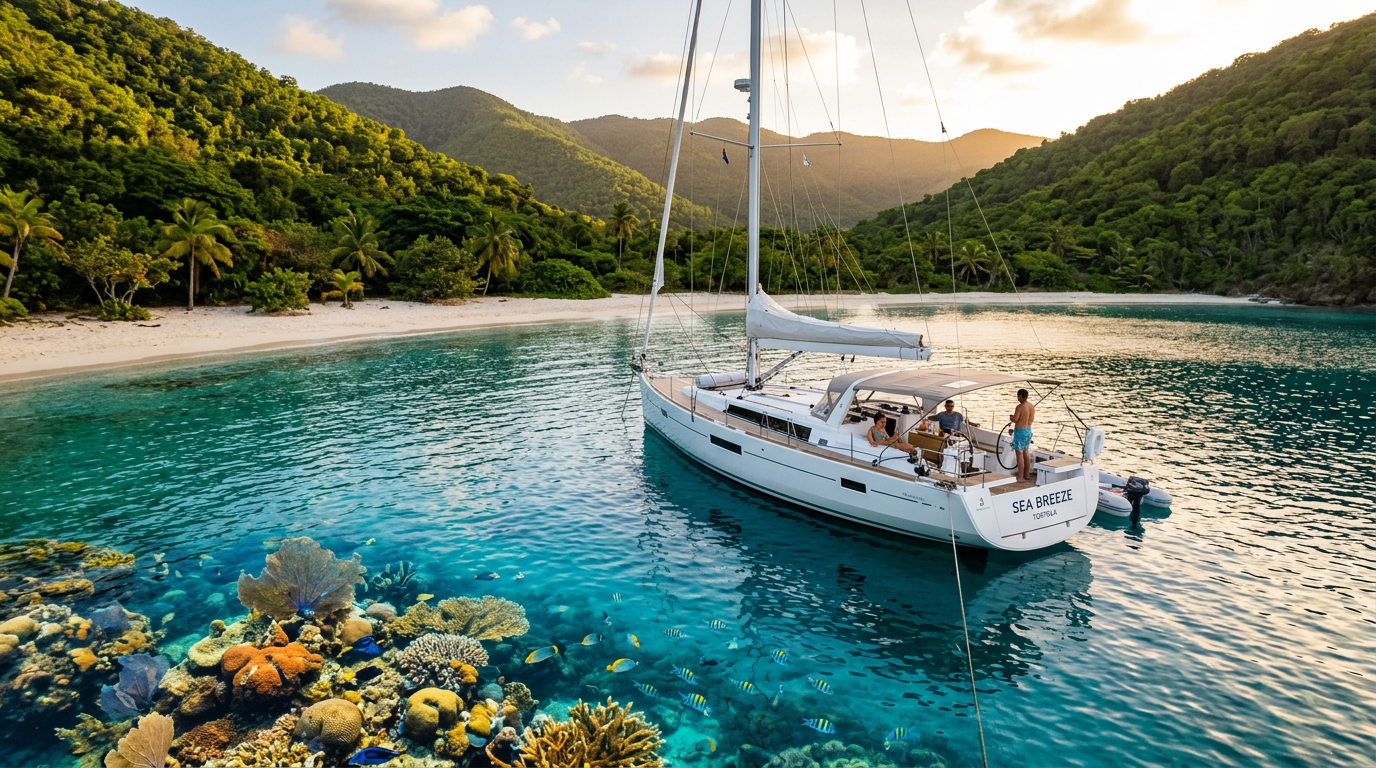
The Caribbean is simultaneously one of the world's most visited and most misunderstood sailing regions. For millions of travellers each year, the Caribbean means the same handful of crowded ports – Nassau, St Maarten, Cozumel – experienced from the decks of enormous ships, often for no more than six hours at a time. This is Caribbean tourism as a spectator sport, and it bears very little resemblance to the Caribbean that sailors, divers, and genuine travellers have been quietly discovering for decades.
The real Caribbean – the one that rewards slower, more intentional travel – is a place of extraordinary diversity. The archipelago stretches over 4,000 kilometres from the Bahamas in the north to Trinidad in the south, and encompasses over 700 islands with distinctly different characters, histories, languages, and cuisines. French, Dutch, English, Spanish, and Creole cultures all meet and mingle here, creating an unpredictable complexity that can feel overwhelming at first and endlessly fascinating once you begin to understand it.
The Grenadines: The Caribbean's Best-Kept Secret
Ask any experienced Caribbean sailor where they would choose to spend a month on the water, and the answer is almost always the same: the Grenadines. This chain of small islands and cays stretching between St Vincent and Grenada represents Caribbean sailing at its purest. The anchorages are protected, the passage winds are reliable, the water is some of the clearest in the world, and the communities are small enough to have retained an authenticity that more visited parts of the Caribbean lost decades ago.
Tobago Cays, a protected marine park within the Grenadines, is widely considered the finest snorkelling location in the eastern Caribbean. The reef systems here are in excellent condition due to the park's protection status, and the diversity of marine life is extraordinary: hawksbill turtles, spotted eagle rays, parrotfish in electric colours, and reef sharks patrol waters of crystalline clarity. Bequia, the largest of the Grenadines at just 18 square kilometres, has a seafaring culture that predates the tourist era; its boatbuilders still construct traditional wooden vessels using techniques passed down through generations.
Mayreau, accessible only by sea and home to fewer than 400 permanent residents, may be the most unspoiled inhabited island in the eastern Caribbean. Its single hilltop village looks out over both the Caribbean Sea and the Atlantic, and on clear days, the string of Tobago Cays is visible on the horizon. There is no airport, no mass tourism, and no pretension. The beach at Saline Bay is one of the finest in the region, and the bar at the top of the hill has been serving rum punches to sailors for longer than anyone can accurately recall.
Dominica: The Nature Island
Dominica – not to be confused with the Dominican Republic – is the most mountainous island in the Lesser Antilles and the Caribbean island least touched by conventional tourism. Its volcanic interior rises to over 1,400 metres and is covered in a rainforest so dense and so varied that Dominica was used as a filming location for multiple productions requiring genuinely primordial jungle. There are no mass-market resorts here, no long stretches of white sand beach; instead, there are hot springs, boiling lakes, underwater volcanic features, and dive sites that rank among the most unusual in the world.
The underwater experience at Dominica is unlike anywhere else in the Caribbean. The island's volcanic activity extends beneath the sea surface, creating warm-water seeps and unusual geological formations that support a distinctive marine community. Seahorses, frogfish, and ghost pipefish are all regularly encountered at dive sites that attract serious underwater photographers from around the world. Above water, the Waitukubuli National Trail – the longest hiking route in the Caribbean at 185 kilometres – winds through landscapes of volcanic grandeur that can make you temporarily forget you are on a Caribbean island at all.
The Dutch Islands: Saba, St Eustatius, and St Barths
The Dutch-affiliated islands of the northern Caribbean occupy a peculiar and fascinating position – physically part of the tropics, politically and culturally connected to Europe. Saba, a volcanic cone rising 877 metres directly from the sea, is perhaps the most eccentric island in the Caribbean. It has no beach – its shoreline is entirely rock and cliff – and its single village, The Bottom, sits in an ancient volcanic crater. Yet divers consider Saba's underwater environment to be among the best in the region: the pinnacles, sea mounts, and deep walls off its coast are covered in black coral and sea fans of extraordinary scale.
St Barths (Saint-Barthélemy) occupies the other end of the spectrum – arguably the most sophisticated island in the Caribbean and certainly one of the most expensive. The island's French character is expressed in extraordinary food, meticulous style, and a certain studied nonchalance that is very French indeed. Its protected anchorage at Gustavia is packed throughout the winter season with some of the most impressive yachts in the world. For visitors who can afford it, St Barths offers a standard of food, wine, and accommodation that would be competitive in Paris or London.
Bonaire: The Diver's Paradise
Bonaire, a Dutch island off the Venezuelan coast, has built its entire identity around diving, and rightly so. The island's protected marine park – one of the first in the Caribbean, established in 1979 – has ensured that its reefs are in exceptional condition. Shore diving here is uniquely accessible: the reef begins just metres from the beach at many points around the island, and the park's yellow stone markers indicate where you can simply walk in with your tank and descend to a world of impressive biodiversity. No boat required, no dive guide mandatory – Bonaire offers a freedom of access to underwater ecosystems that is rare in the modern Caribbean.
The flamingo population at Bonaire's salt flats is another attraction that surprises first-time visitors. Thousands of Caribbean flamingos nest at the salt ponds on the island's southern tip, their pink colouring so vivid against the white salt and turquoise sea that they appear almost unreal. The island's commitment to ecological conservation is genuine and comprehensive: Bonaire has established a reputation as one of the most environmentally responsible tourist destinations in the entire region.
Navigating Off the Beaten Path
Exploring the Caribbean's hidden ports requires a different kind of preparation than conventional tourism. Smaller islands often have no marina facilities, meaning anchoring knowledge is essential. Some of the best anchorages require careful navigation through coral-filled approaches that demand both confidence and up-to-date charts. Weather patterns in the Caribbean are generally reliable in the trade wind season (November to May), but local knowledge remains invaluable – particularly in areas like the Grenadines, where wind acceleration between islands can catch the unprepared by surprise.
The reward for this preparation is access to a Caribbean that the majority of visitors never see. Remote anchorages where you may be the only vessel. Villages where the arrival of a small boat is still an occasion for genuine curiosity and hospitality. Food cooked from whatever was caught that morning. Music that emerges spontaneously from porches and bars without amplification or commercial intent. This is the Caribbean that sustains a deep and lasting love affair with those who take the time to find it.