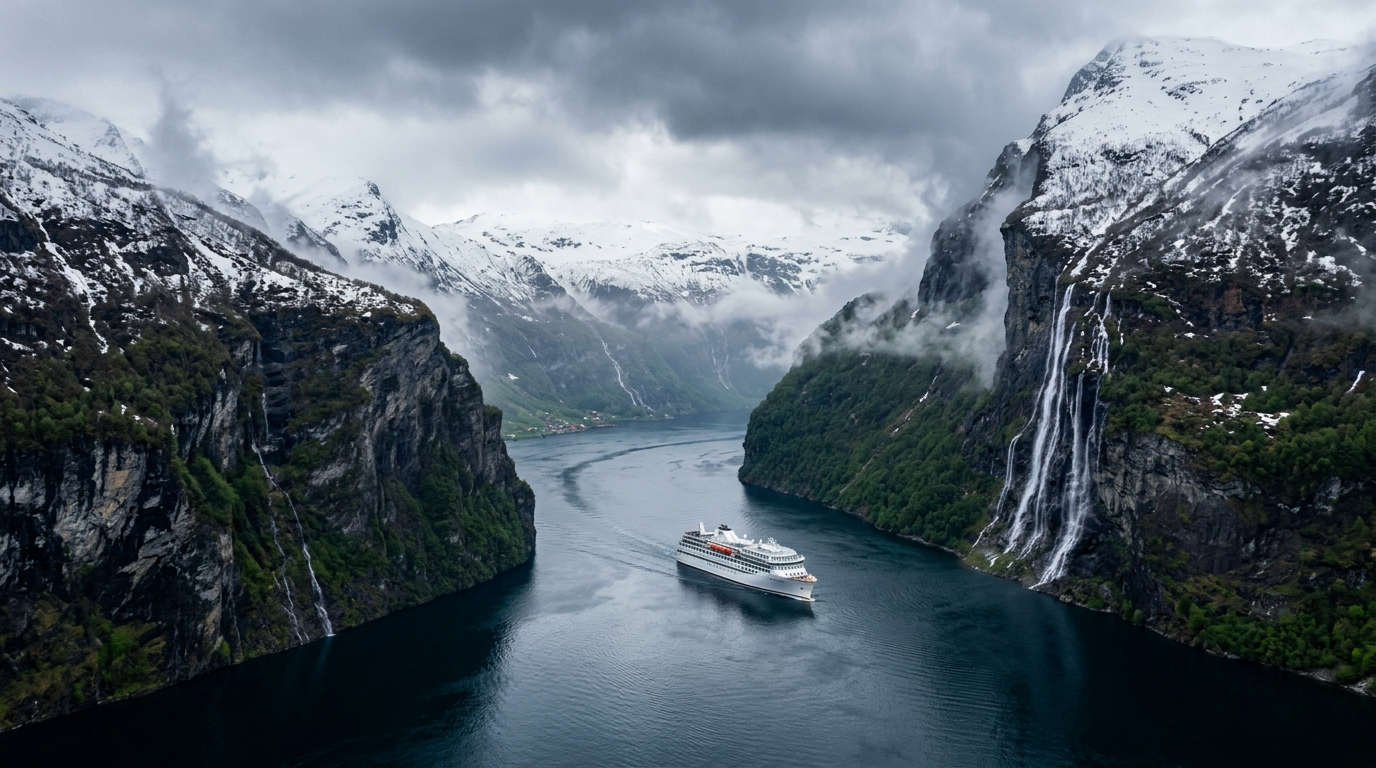
Norway's western coastline is one of the most geologically spectacular places on Earth. Carved by glaciers over millions of years, the Norwegian fjords extend deep into a mountainous interior that receives some of the highest annual rainfall in Europe – a fact that explains, in part, why the waterfalls here are so relentless, so numerous, and so breathtaking. Seeing the fjords by ship is widely considered the finest way to experience them, offering perspectives impossible from the roads that wind along their shores.
The word "fjord" itself comes from the Old Norse for "where one fares through," and the word carries a sense of journey that is entirely appropriate. Navigating a fjord is not merely sightseeing; it is passage through a landscape that feels primordial, untouched, and slightly overwhelming in the best possible sense. The scale of these features dwarfs even the largest vessels. Sognefjord, the longest and deepest fjord in Norway at 204 kilometres and 1,308 metres deep, makes a cruise ship feel like a toy in a bathtub.
The Big Four: Norway's Most Famous Fjords
Sognefjord, Hardangerfjord, Geirangerfjord, and Nærøyfjord represent what most travellers imagine when they think of Norwegian fjord scenery, and none of them disappoints. Sognefjord, which extends eastward from the coast near Bergen deep into the heart of Norway, is the queen of them all. Its sheer scale is incomprehensible until you are actually in it: the cliffs rise to over 1,700 metres on either side, and the water below you is deeper than the North Sea. Branching off Sognefjord is the narrower Nærøyfjord, one of the most visually intense stretches of water in the world and a UNESCO World Heritage Site alongside neighbouring Geirangerfjord.
Geirangerfjord is perhaps the most photographed fjord in Norway, and it is not difficult to understand why. The Seven Sisters waterfall – seven separate strands of white water plunging in parallel from the cliff edge above – is one of the most iconic images in Scandinavian nature. Across the fjord, the Suitor waterfall responds to the Seven Sisters as if in answer. The village of Geiranger, at the head of the fjord, is tiny but has all the services a short-stay visitor needs, and the Dalsnibba viewpoint above it offers what many consider the finest panoramic view in Norway.
Hardangerfjord, slightly south of the other three, has a gentler character that is no less beautiful. Spring here – particularly late April and early May – brings one of Norway's great natural spectacles: the blossoming of the apple and cherry orchards on the fjord's southern shores. The Hardanger region is the heartland of Norwegian fruit farming, and the sight of white and pink blossom against a backdrop of snow-capped mountains and blue water is genuinely one of the loveliest things a traveller in Norway can witness.
The Northern Fjords: Into the Arctic
Beyond the famous four lies an entire coastline of fjords stretching north towards the Arctic Circle and beyond. The Lofoten Islands, though technically islands rather than fjords in the traditional sense, rise from the sea with such dramatic verticality that they create a fjord-like effect of walls and water. The fishing villages here – Reine, Å, Henningsvær – are among the most photographed in Norway, their red and yellow wooden houses reflected perfectly in still water with serrated mountain peaks behind them. Arriving in the Lofotens by sea, particularly in the long evening light of a Norwegian summer, is an experience of considerable emotional intensity.
Further north still, Tromsø sits 350 kilometres above the Arctic Circle and serves as a gateway to some of the most remote fjord scenery in Europe. The Lyngen Alps, rising directly from the fjord waters east of Tromsø, create a spectacle that combines glacial ice, rocky peaks, and Arctic sea in a manner unlike anything further south. In winter, the fjords of northern Norway become a backdrop for the aurora borealis, which dances above the dark water in curtains of green and violet light. Summer brings the midnight sun, which sets a golden light across everything for weeks at a time and makes conventional concepts of day and night entirely irrelevant.
Bergen: The Gateway to the Fjords
Most fjord cruises begin or end in Bergen, and the city merits more than a cursory visit. As Norway's second city, Bergen has a maritime character that is inseparable from its history as the dominant Hanseatic trading port of northern Europe. The Bryggen wharf, with its distinctive row of coloured wooden warehouses dating from the 14th century, is a UNESCO World Heritage Site and one of the most recognisable urban scenes in Scandinavia. The fish market at Torget has been operating since the 1200s; the smoked salmon and fresh shrimp sold there remain among the finest in the world.
Bergen's setting is remarkable: the city is surrounded by seven mountains, each accessible by funicular or hiking trail, offering panoramic views over the fjord system that extends westward to the sea. The Fløibanen funicular, running to the summit of Mount Fløyen, is one of the most popular attractions in Norway and gives visitors a perspective on the city's relationship to its natural environment that clarifies everything else.
Wildlife and Natural Phenomena
The Norwegian fjords are not simply scenic; they are ecologically rich in ways that add another dimension to any voyage. White-tailed eagles – the largest eagles in Europe – are a regular sight in the more remote fjords, soaring on thermals above the cliff faces or diving into the water for fish. Porpoises are common in the outer fjords; orcas and humpback whales visit the northern waters in pursuit of herring shoals, particularly in autumn and early winter.
The fjords' geology reveals millions of years of planetary history in the rock faces that rise from the water. Layers of schist, granite, and quartzite are clearly visible, their colours varying from grey-blue to pink to near-white depending on the mineral composition. In some areas, traces of the last Ice Age are still clearly legible in the landscape: polished rock surfaces, U-shaped valleys, and the characteristic striated grooves left by moving glaciers on the stone beneath.
Planning Your Fjord Voyage
The best season for fjord cruising is broadly May through September, with June and July offering the longest daylight hours and the most reliable weather. Spring brings the waterfalls to maximum flow as snowmelt from the mountains peaks; autumn brings dramatic cloud formations, occasional storms, and the first autumn colours on the hillsides. Winter cruising in the fjords is adventurous and increasingly popular among those seeking the aurora borealis, but it requires appropriate preparation and a tolerance for short days and uncertain weather.
Smaller vessels can access narrower fjords and more remote anchorages, while larger ships are limited to the main routes. Expedition-style small ships that accommodate 50–200 passengers have become the preferred choice for serious fjord enthusiasts, offering both Zodiac tender access to remote areas and the expertise of naturalist guides who can interpret what you are seeing. Whatever size of vessel you choose, the Norwegian fjords will meet and probably exceed your expectations – these are landscapes of a profundity that very few places on Earth can match.