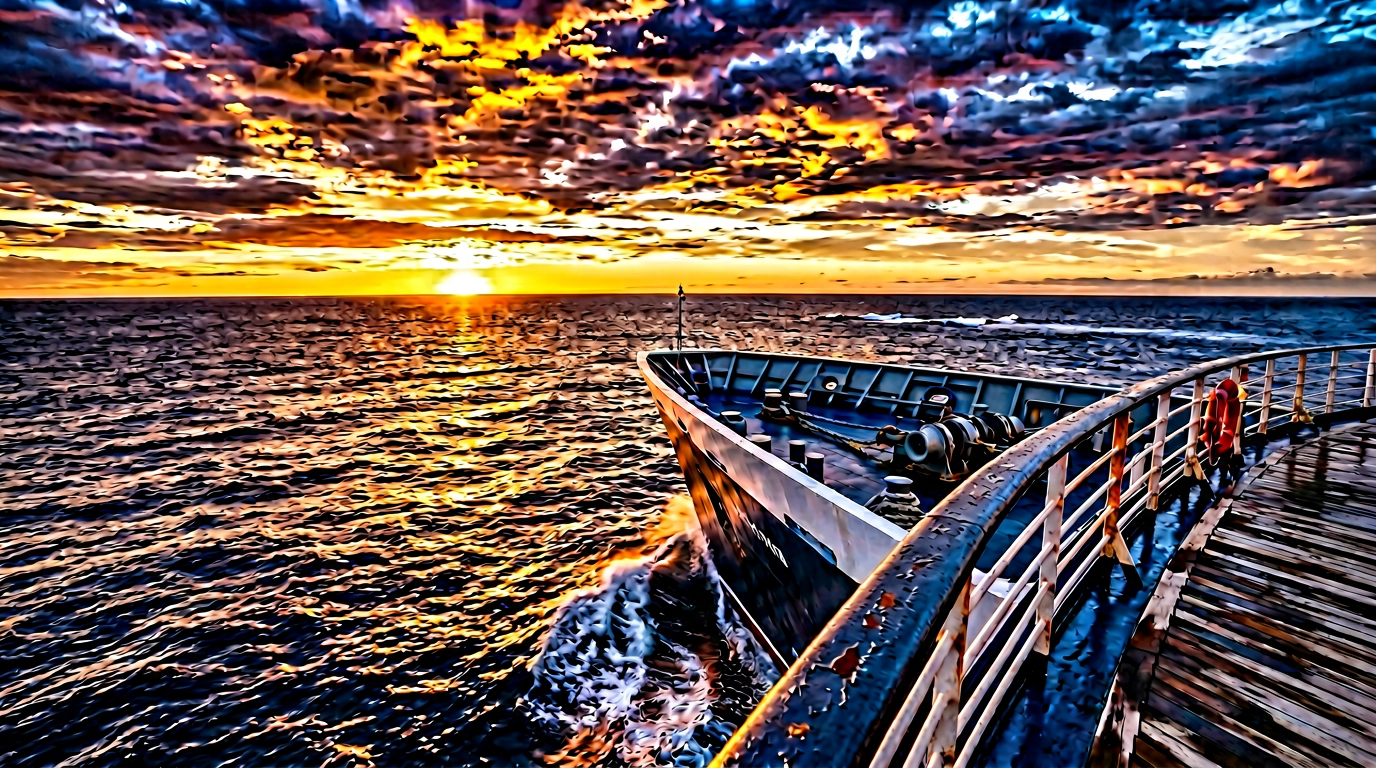
The Pacific Ocean is the largest single geographical feature on our planet. It covers approximately 165 million square kilometres – more than all of Earth's landmasses combined. Crossing it by ship is not merely a journey from one port to another; it is an immersion in scale, solitude, and perspective that has no equivalent in modern travel. For many who have made the crossing, it represents the point at which they understood, perhaps for the first time, how genuinely large the Earth is.
The most popular transpacific cruise routes run between North America's west coast – typically Los Angeles, San Francisco, or Vancouver – and Sydney or Auckland in the Antipodes. These voyages take between 18 and 28 days depending on the itinerary and the number of intermediate ports. The route passes through some of the most remote inhabited places on Earth: Hawaii, Tahiti and French Polynesia, Samoa, Tonga, Fiji, and New Zealand. Each of these island groups deserves far more time than a single port day allows, but even brief visits create powerful impressions that remain long after the ship has moved on.
The Sea Days: Learning to Love the Open Ocean
Perhaps the greatest challenge – and ultimately the greatest reward – of a transpacific crossing is learning to appreciate sea days. On a voyage of three weeks, there will be stretches of four, five, or even seven consecutive days without sight of land. For experienced ocean travellers, these days are often described as the best part of the journey. The ship's community develops its own rhythms and routines. Relationships form with fellow passengers that would be impossible in shorter, more fragmented travel. And the ocean itself – constantly changing in colour, texture, and mood – provides a spectacle that is never actually boring, though it can take a few days to learn to see it properly.
The Pacific night sky, far from any light pollution, offers astronomical spectacle of extraordinary quality. The Milky Way is visible as a structural feature of the sky rather than a faint smear, and on clear nights the southern constellations – Scorpius, the Southern Cross, Centaurus – rise above the horizon in configurations that feel alien to anyone raised in the northern hemisphere. The Southern Cross, visible from tropical latitudes throughout the crossing, has guided Pacific navigators for centuries; seeing it properly for the first time, from the deck of a ship in genuine ocean darkness, is a quietly significant moment.
Hawaii: The Crossing's First Jewel
Hawaii is typically the first major port of call on a westbound transpacific crossing, reached after five to seven days at sea from the US west coast. The Big Island of Hawaii, with its active volcanic landscapes, offers a dramatically different experience from the resort-focused tourism of Maui and Oahu. Hawaii Volcanoes National Park – where you can walk to within safe distance of active lava fields and look into the crater of Kilauea – is one of the few places on Earth where you can witness the planet actively building itself. The contrast between the black lava fields descending to the sea and the lush tropical forest above them creates a landscape of extraordinary visual complexity.
Maui's Road to Hana is one of the most celebrated coastal drives in the United States, but it is equally rewarding approached by sea. The island's north coast, largely inaccessible by road due to the sea cliffs of the Nā Pali coastline equivalent, reveals itself entirely differently from the water: a procession of waterfalls, green valleys, and volcanic peaks culminating in the 3,055-metre summit of Haleakalā, Hawaii's dormant shield volcano. Snorkelling at Molokini Crater – a partially submerged volcanic caldera – provides excellent visibility and diverse reef fish populations in a genuinely otherworldly setting.
French Polynesia: The Islands of Dreams
French Polynesia represents the definitive Pacific island experience for many transpacific voyagers. Bora Bora – whose lagoon of improbable turquoise, framed by the jagged remnants of an ancient volcanic cone, appears in every Pacific paradise fantasy – lives up to its reputation in person, though it requires some effort to look past the overwater bungalow infrastructure to the natural environment that makes it extraordinary. The reef system is spectacular; the passage between the lagoon and the open sea is navigable by tender for particularly dramatic snorkelling and diving.
Rangiroa, a remote atoll in the Tuamotu archipelago, offers an entirely different character. This vast ring of coral encloses a lagoon so large – 75 kilometres long and 25 kilometres wide – that the interior horizon appears to be open ocean. The passes through the atoll wall, where the Pacific surge creates powerful currents, are among the finest drift dives in the world: grey reef sharks, eagle rays, and schools of jack cruise the passes in numbers that can be overwhelming. Marquesas Islands, even further north and less visited, reward the adventurous with black sand beaches, ancient tiki sculptures, and communities that maintain traditional Polynesian arts of tattooing, woodcarving, and tapa cloth-making.
Fiji and Tonga: Melanesian and Polynesian Worlds
The Fijian archipelago – over 300 islands spread across 1.3 million square kilometres of ocean – offers diving and snorkelling that many underwater photographers consider the finest in the Pacific. The soft coral gardens of the Somosomo Strait on Taveuni, known as the Rainbow Reef, are famous for their density of colour and marine life diversity. Fiji's surface culture is equally rewarding: the warmth of a Fijian welcome (the "Bula!" greeting, offered with genuine enthusiasm rather than commercial obligation, remains one of the most pleasant greetings in any culture) and the elaborate kava ceremony are aspects of Melanesian culture that leave a lasting impression.
Tonga, a constitutional monarchy and the only Pacific nation never colonised by a European power, maintains a cultural distinctiveness that is palpable even on a brief visit. The Vava'u island group is one of the prime locations in the Pacific for humpback whale encounters: between July and October, migrating humpbacks use the protected waters around Vava'u as a nursery area, and responsible swimming-with-whales operators offer encounters that can be profoundly moving.
Arriving in New Zealand or Australia
The final approach to New Zealand or Australia after weeks at sea carries an emotional charge that is difficult to adequately describe. After days of open ocean, the first sight of the New Zealand coastline – mountains rising from green hills, the smell of vegetation after nothing but salt air – produces a sensory reset that many transpacific voyagers describe as one of the most vivid memories of their entire journey. Arriving in Sydney Harbour under the Harbour Bridge, with the Opera House catching the morning light, is a finale worthy of the extraordinary journey that precedes it.
A transpacific crossing is not a holiday in any ordinary sense. It is a sustained experience of planetary scale, an education in patience and attention, and a reminder that the world is genuinely, abundantly larger and more varied than daily life typically reveals. For those who are ready for it, there is nothing quite like it.