There is a well-documented paradox at the heart of contemporary travel: people invest significant time, money, and effort in reaching remarkable places, and then spend much of the time they are there in a state of distracted semi-presence. The phone is the most obvious culprit – the compulsive checking of messages and social media, the photographing of every experience rather than inhabiting it, the virtual performance of travel for audiences at home that displaces the actual experience of being somewhere. But the phone is only the most visible manifestation of a deeper tendency to process experience at one remove, to narrate and curate rather than simply to be.
Mindfulness practice – the deliberate cultivation of present-moment awareness, developed through formal meditation and increasingly brought into ordinary daily activities – offers a practical counter to this tendency. When applied to travel, it produces a qualitatively different kind of experience: more vivid, more memorable, more deeply satisfying, and more genuinely restorative. The traveller who arrives in a new port and spends twenty minutes standing still, deliberately attending to the smells, sounds, colours, and quality of light of the place, will carry a richer impression of that place home than one who hurries through the same port photographing it for an hour.
The Ocean as a Natural Mindfulness Environment
The open ocean is one of the most naturally conducive environments for mindfulness practice that the natural world provides. The unobstructed horizon engages a kind of attention that is qualitatively different from attention in cluttered environments: broad, panoramic, unhurried, and naturally drawn toward the present moment rather than mental reconstruction of the past or anticipation of the future. Psychological research supports the intuitive sense that ocean environments are particularly effective at reducing mental rumination, reducing physiological stress markers, and inducing what neuroscientists call "soft fascination" – a relaxed, attentive state that allows the mind's default mode network to quiet and more deliberate awareness to emerge.
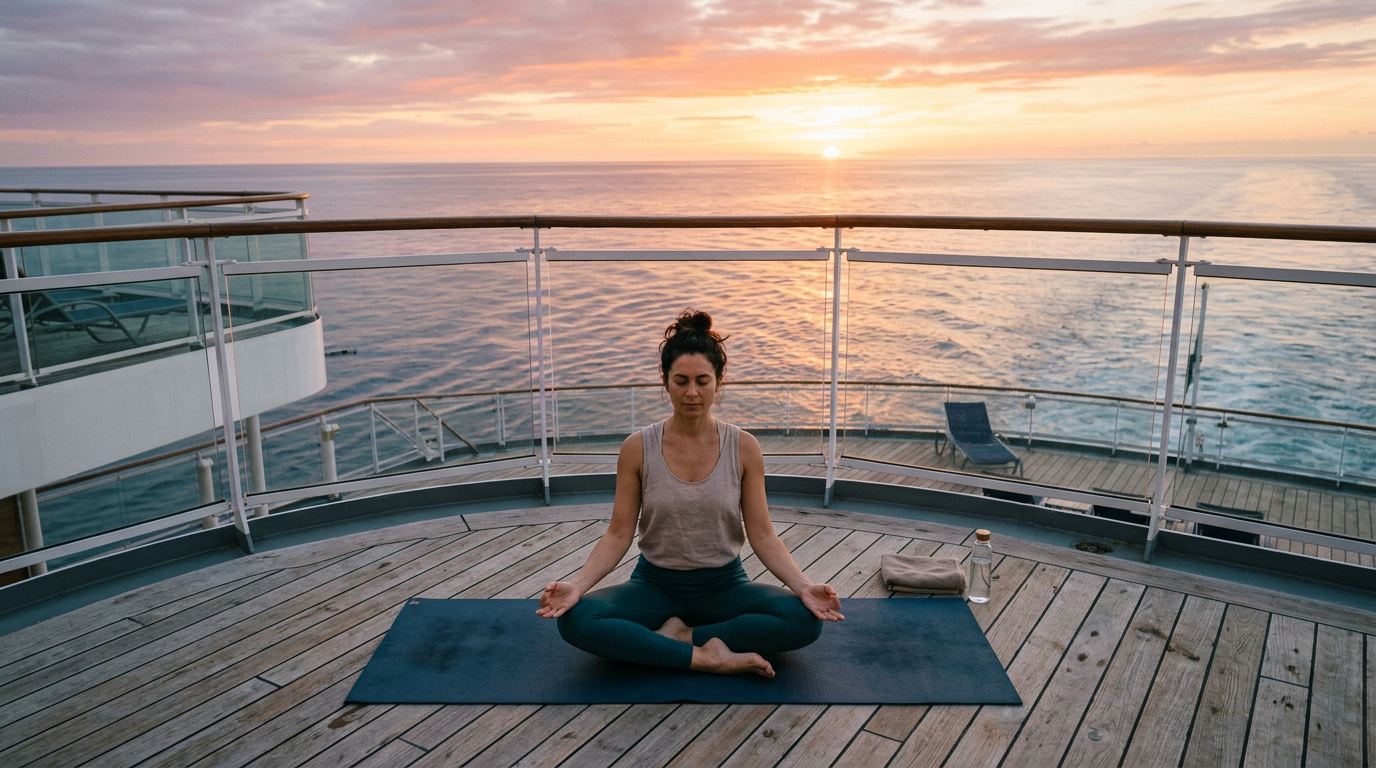
A practice as simple as spending twenty minutes each morning on deck, without phone or book, directing attention to the sensory qualities of the ocean – the colour and movement of the water, the character of the light, the sound and smell of the sea air, the sensation of temperature and wind against the skin – constitutes a form of mindfulness meditation that is both accessible and highly effective. Many practitioners report that regular deck meditation during sea voyages produces a quality of mental clarity and emotional equilibrium that formal sitting practice on land, however disciplined, rarely matches.
Mindful Port Exploration
The approach to port visits can be transformed by basic mindfulness principles. Rather than arriving with a checklist of sites to visit and a schedule that presses toward maximum coverage, the mindful traveller arrives with a looser intention and a willingness to be directed by what is actually present and interesting. The willingness to stop, to sit in a public square and simply observe the life moving through it for thirty minutes, to enter a church or market without specific purpose and allow attention to be drawn by whatever is genuinely arresting – these behaviours produce encounters with the reality of a place that itinerary-driven tourism consistently misses.
Mindful eating is another practice with particular relevance to travel. Rather than eating primarily for fuel or social obligation, attending deliberately to the flavours, textures, and qualities of unfamiliar food creates an experience that is more pleasurable, more memorable, and more genuinely informative about the place and culture in which the food was produced. Taking time to eat slowly, to notice what is distinctive about local ingredients and preparations, and to feel genuine curiosity about the origin and history of what is being consumed transforms a meal from an interruption to an experience.
Formal Practice on the Road
Maintaining a formal mindfulness meditation practice while travelling is both possible and highly valuable, particularly on longer journeys where the cumulative effects of new environments, social demands, and altered routines can create sustained cognitive and emotional fatigue. A daily practice of even ten to fifteen minutes – seated, attending to the breath, and repeatedly redirecting attention when it wanders – provides a form of mental recovery that physical rest does not offer and that no other intervention reliably matches.
The conditions required for formal meditation practice are modest: a reasonably quiet space, a comfortable seated position, and a period of time that will not be interrupted. All of these are achievable in most travel contexts, including cruise ship cabins, hotel rooms, and quiet corners of public spaces. A cruise ship cabin in the early morning, before the ship's day begins, with the porthole open to the sound of the sea, provides as good a meditation environment as most dedicated practice spaces on land. The investment of fifteen minutes each morning in this way reliably produces a quality of presence and equanimity for the rest of the day that makes the entire travel experience richer.
There is, ultimately, something deeply appropriate about combining mindfulness practice with maritime travel. Both involve a willingness to relinquish control of direction and outcome, to be present with what is actually happening rather than what was planned or hoped for, and to find beauty and meaning in the immediate sensory reality of the moment rather than in the accumulated record of places visited and experiences consumed. The sea teaches this lesson continuously to those who are willing to learn it.