Sleep is not a luxury during travel; it is the physiological foundation on which everything else rests. The traveller who consistently sleeps well navigates unfamiliar environments more confidently, tolerates the inevitable frictions of transit more patiently, retains new experiences more vividly, and returns home refreshed rather than depleted. Conversely, chronic sleep deprivation during travel – a condition that many travellers accept as inevitable – degrades cognitive performance, impairs emotional regulation, reduces immunity, and converts what should be an enjoyable experience into an endurance exercise.
The causes of sleep disruption during travel are multiple and interact with each other in ways that amplify their individual effects. Circadian disruption from crossing time zones is the most familiar; the internal body clock, which has been calibrated over millions of years to synchronise with the local light-dark cycle, cannot adjust instantaneously to a new schedule when that schedule differs significantly from the one it has been following. The lag between the body's internal time and the external environment's time produces the cluster of symptoms familiar as jet lag: daytime fatigue, nocturnal wakefulness, impaired concentration, and general malaise that can persist for several days after a significant time-zone transition.
Managing Jet Lag: The Evidence Base
The science of jet lag management has advanced considerably, and several evidence-based strategies can substantially reduce recovery time after long-haul flights. Light exposure is the most powerful tool available for shifting the circadian clock: exposing yourself to bright natural light at the appropriate time in your destination's day – morning light for eastward travel, late-afternoon light for westward travel – accelerates entrainment of the body clock to the new schedule more effectively than any other intervention. Conversely, avoiding bright light at the wrong times (the middle of the subjective night in your origin time zone) is equally important.
Melatonin, when used appropriately, can also meaningfully accelerate circadian adjustment. Taken at the beginning of the sleep period in the destination time zone – even if this feels counterintuitive – melatonin signals to the body clock that it is time to shift phase. The evidence for doses at the lower end of available preparations (0.5 to 1mg) is as good as or better than higher doses, which can cause grogginess the following morning. Consulting a healthcare professional before using melatonin is advisable, particularly for travellers with other health considerations.
Sleeping on Aircraft
Aircraft cabins are physiologically challenging sleep environments. The combination of low humidity (typically 10-20%, well below the 40-60% of comfortable indoor environments), reduced cabin pressure equivalent to an altitude of 6,000-8,000 feet, sustained low-level noise from engines and air conditioning, and the discomfort of economy-class seating creates conditions in which restful sleep is genuinely difficult to achieve without deliberate preparation. However, even imperfect sleep on long-haul flights is significantly better for arrival condition than no sleep at all, and several strategies can meaningfully improve sleep quality.
Noise-cancelling headphones have become indispensable for frequent long-haul travellers. The continuous noise of an aircraft engine falls primarily in the frequency range where noise-cancelling technology is most effective, and good-quality active noise cancellation reduces perceived noise levels enough to make sleep substantially easier. Combined with an eye mask – even a simple one that blocks cabin lighting – and a travel pillow configured to support the neck in a neutral position, these relatively modest investments in comfort pay substantial dividends in sleep quality on long flights.
Sleep Quality at Sea
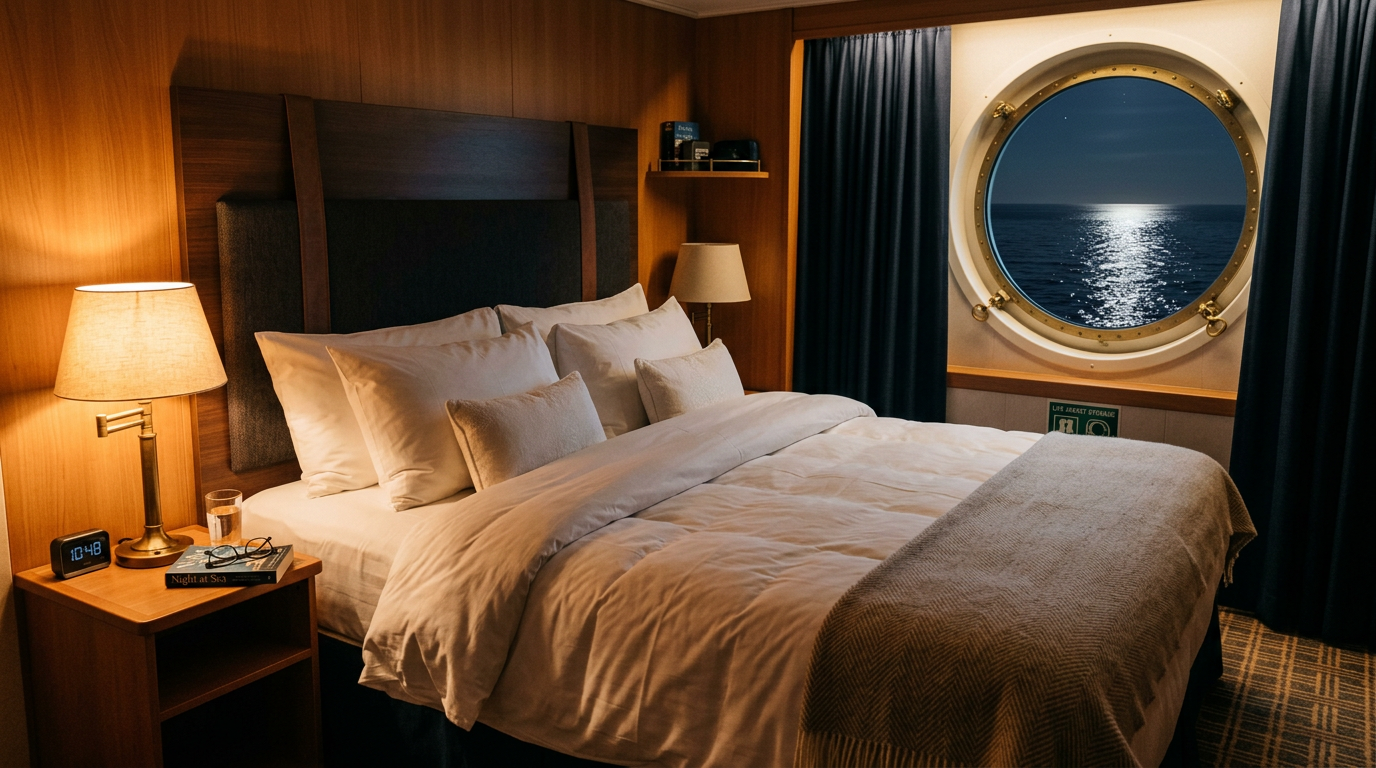
Ships have a paradoxical effect on sleep. On the one hand, the gentle motion of a vessel in calm to moderate seas is genuinely soporific for most people: the slow rocking motion activates sensory pathways associated with early childhood sleep, producing the "rocked to sleep" effect that many passengers report as one of the unexpected pleasures of sea travel. On the other hand, the same motion, when it intensifies in rougher conditions, can produce the nausea and disorientation of motion sickness that makes sleep (and most other things) impossible.
Cabin choice matters more for sleep quality than many travellers realise. Midship cabins on lower passenger decks experience significantly less motion than cabins toward the bow or stern, and significantly less noise than cabins near engine rooms or entertainment venues. The cost premium for an appropriately positioned cabin is worth considering carefully from a sleep quality perspective on longer voyages: the difference between a well-chosen and a poorly-chosen cabin in terms of noise and motion can be the difference between eight hours of excellent sleep and a night of repeatedly disrupted rest.
Creating a Sleep Environment
The body sleeps best in a cool (around 18-19°C), dark, quiet environment. Achieving these conditions in transit environments and unfamiliar accommodation requires some active management. A travel eye mask and compact earplugs or earphones weigh almost nothing but provide meaningful control over two of the three environmental variables. Temperature is harder to control in hotel rooms and ship cabins; most ship cabins have individual climate control that should be set to the cool end of the comfortable range before attempting sleep.
Consistency of pre-sleep routine has a strong evidence base as a sleep quality enhancer. The sequence of activities in the hour before sleep – the transition from active engagement to quiet wind-down – signals to the nervous system that sleep is approaching and prepares the physiological systems that support sleep onset. Maintaining this routine as consistently as possible during travel, even in different time zones, provides a stable cue for sleep that partially compensates for the disorientation of an unfamiliar environment. This might mean reading rather than watching television in the hour before bed, avoiding intense exercise close to sleep time, and minimising bright screen exposure in the wind-down period.
The practical message is both simple and genuinely liberating: good sleep during travel is not primarily a matter of luck or of having the right body type. It is, in large part, a skill that can be learned and refined with deliberate attention. Travellers who invest the modest effort required to understand their own sleep patterns, equip themselves appropriately, and manage their light exposure and activity timing intelligently will find that quality sleep during travel is entirely achievable – and that its achievement transforms the experience of being somewhere new into something close to its theoretical ideal.